

Last week, I looked at what Rick Warren’s 1995 classic The Purpose Driven Church can teach the Left about recruitment in our atomized era. But getting people through the door is only half the battle. Seeker-sensitive evangelicalism didn’t buck America’s decades-long decline in membership organizations simply by attracting crowds. It couldn’t have grown without systematically turning newcomers into members, members into leaders, and leaders into recruiters.
As Warren puts it, “Our ultimate goal at Saddleback is to turn an audience into an army.” This is where the Left is weakest. Radical and progressive organizations generally lose most people we bring in and develop only a fraction of the rest into organizers able and willing to recruit those around them.
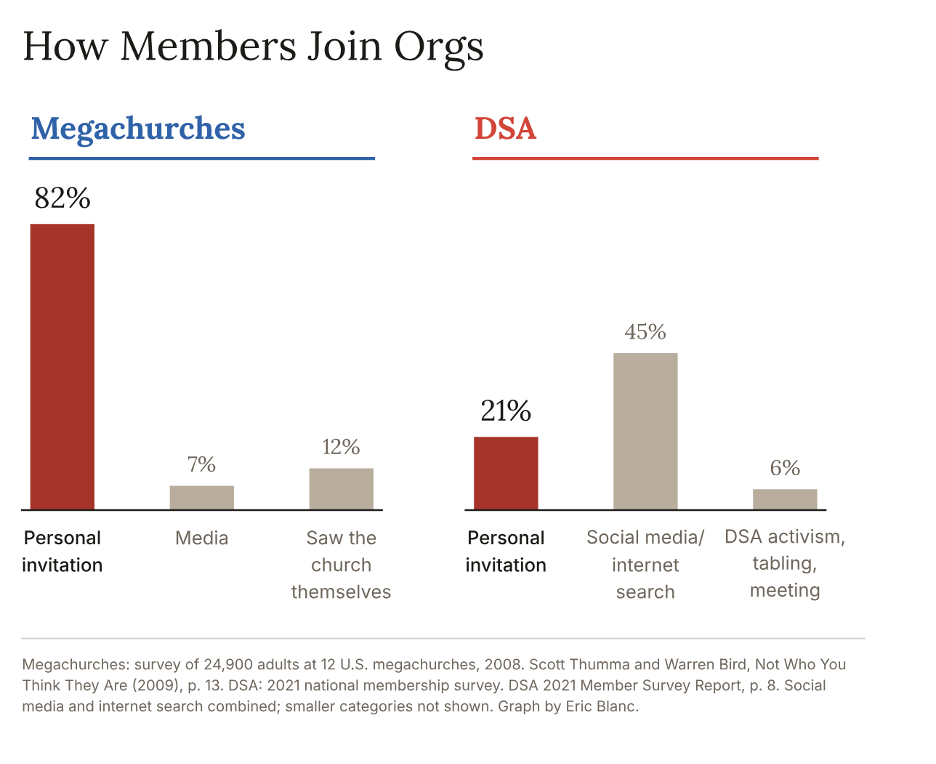
Survey data shows a dramatic difference between how today’s evangelicals and leftists recruit. Whereas 82% of megachurch attendees first heard of their church via a personal invitation from a co-worker, friend, or family member, the same was true for only 21% of Democratic Socialists of America (DSA) members. This reliance on media rather than personal invitations is also the norm among progressives in the US and abroad.
What would it take for the Left to turn this around? Many answers can be found in The Purpose Driven Church. More than a collection of organizing tips, it offers a model for how to generate self-reinforcing growth: belonging fosters commitment; commitment opens the door to training; training and responsibility develop leaders; and those leaders bring in new people who repeat the process.
In an era when community is far less likely to arise organically from daily life, moving toward a similarly systematic model is indispensable. Of course, leftists’ opponents are more powerful, and our organizations must be more democratic. But if we’re going to move beyond relying on social media and news headlines to recruit self-selecting, college-educated activists, we need to learn how to consistently develop supporters into leaders and recruiters. Warren’s model offers ten lessons for making that shift.
1. Get smaller to get bigger
“Our church must always be growing larger and smaller at the same time,” Warren likes to say. Each size does a different job. “Large group celebrations give people the feeling that they are a part of something significant.” Small groups, on the other hand, “are perfect for creating a sense of intimacy and close fellowship. It’s there that everybody knows your name. When you are absent, people notice.”
At Saddleback, small groups consist of about a dozen people who meet weekly to collectively study, volunteer, break bread, and lend support to each other. They meet in homes because homes are free, relaxed, quicker to get to in sprawled-out Orange County, and “infinitely expandable.” Volunteer leaders run the small groups, with trained lay pastors overseeing group clusters.
Warren warns that when church is all lecture (“Sit still while I instill”), people can attend for a year without making a friend. He urges including some relational activity in every gathering and swears by weekend retreats: “The amount of time a person spends with other members at a single forty-eight-hour retreat is greater than the time they will spend together on Sundays over a year.”
Behind all this is a simple finding about why people stay. As Warren writes, “Relationships are the glue that holds a church together.” National surveys find that about 40-60% of megachurch Sunday attendees participate in at least one small group.
Apart from strong union organizing committees, most of our organizations have no equivalent to evangelicals’ weekly small groups or the Belgian Workers’ Party’s analogous groupes de base.
2. Build a robust ladder of commitment
Warren explains that people sit at different levels of commitment and that an organization’s job is to move them up the ladder, step by step. Saddleback pictured this as five concentric circles, with the following mid-1990s figures:
• Community: 31,000 people who had visited at least four times in a year
• Crowd: 10,000 regular weekend attenders
• Congregation: 5,000 official members
• Committed: 3,500 members who had signed a covenant to pray daily, tithe, and join a small group
• Core: 1,500 lay ministers who ran the church’s work
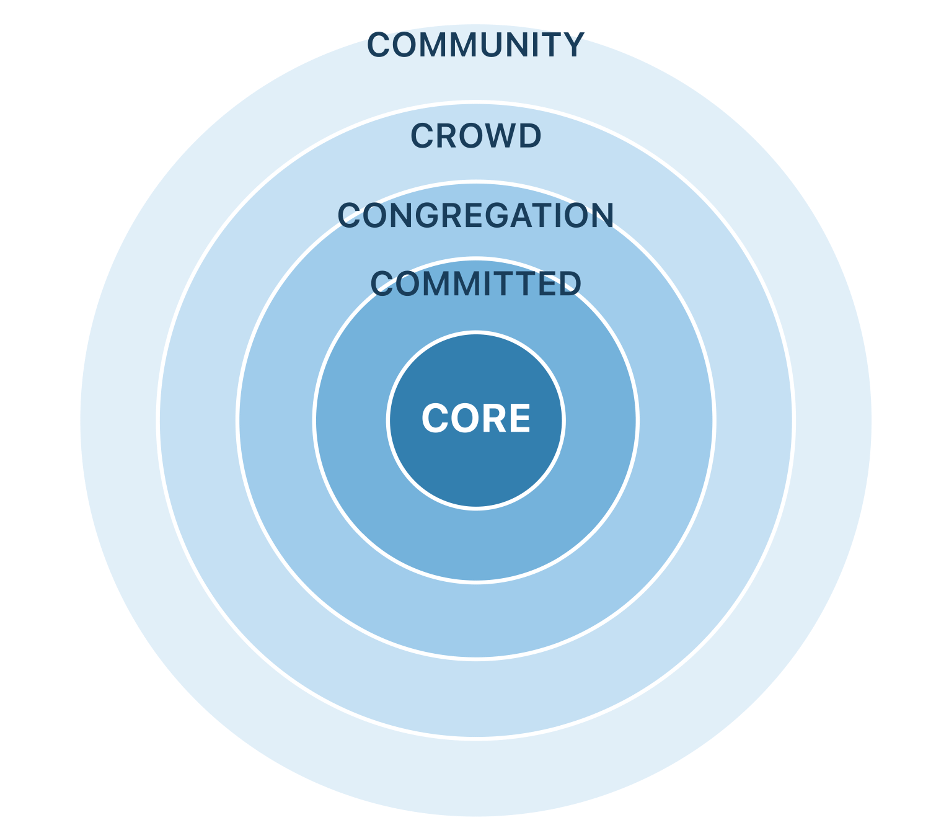
The point is to systematically move them inward. “A crowd is not a church—but a crowd can be turned into a church,” he writes. And the process doesn’t end at the center: “What happens when people finally get to the core? We move them back out into the community for ministry!”
To make the ladder concrete, Saddleback used a baseball diamond. At each base, newcomers completed a class and signed a covenant: membership (101), maturity (201), ministry (301), and evangelism (401).
In most churches, members stall halfway around. To avoid this, Warren insists that the organization, not just the newcomer, is responsible for making the climb happen. “Many churches mistakenly assume that once a person has received Christ, the sale has been consummated, and it is now up to the new believer to follow through with his commitment and join the church. This is nonsense.” Instead, “It is the church’s responsibility to take the initiative in assimilating new people into the congregation.”
Many progressive and leftist chapters have some form of ladder of engagement, but few groups have made it anywhere near as visible and systematic as Saddleback. Too often, the ladder collapses into two rungs: a mass event (a rally, a canvass shift, an email list) and a small, burnt-out staff or volunteer cadre who do everything else, with few clearly laid-out steps in between.
As exciting as it is that DSA is now 130,000 strong, we shouldn’t overlook the fact that roughly two-thirds of members who joined during our first big surge after 2016 left within five years and that almost half of all former members left after just one year. As was explained earlier this year in Democratic Left, “overall, member retention rates are basically unchanged since 2020.” Imagine, instead, a clear path from event attendee to dues-paying member to small-group member to trained organizer who recruits others, with a short class and a clear commitment at each step. And not just in big electoral campaigns, but year-round.
3. Instill ideology via organizing
Megachurches are often dismissed as superficial spectacles consisting of little more than charismatic preachers, self-help fluff, and smart marketing techniques. That’s true enough for some fringe Prosperity Gospel-type churches, but such a critique misses the mark when it comes to Warren’s theory or Saddleback’s practice.
Community and appealing services help get people in the door, but ideology is also indispensable to the model, especially because it inspires the conviction needed to sustain members’ commitment. “No one stays with a difficult task unless they are convinced there is a good reason for doing so,” he notes. During Saddleback’s early years, when volunteers had to set up and tear down everything each Sunday, Warren found himself exhausted, lugging equipment after half the crew failed to show. His lesson: “You must know why you do what you do or else you’ll be defeated by discouragement.”
But Warren didn’t rely on sermons to spread conviction. “Conviction is contagious: People acquire it by being around other people who have it.” Proximity to conviction, Warren notes, is a major reason Saddleback emphasizes small groups.
Nor does Warren think recruitment can depend on big ideas alone; immediate needs are normally the main motivating factor: “While most unbelievers aren’t looking for truth, they are looking for relief. This gives us the opportunity to interest them in truth.” Once people were inside, Saddleback emphasized systematic ideological education, offering nine-month Bible study courses and a theology course covering twelve foundational Christian doctrines, taught twice weekly over twenty-seven weeks.
Progressive activists feel strongly about many issues, but often lack an overarching way to make sense of the world and give meaning to individuals’ efforts within it. Socialists do have such an ideology — and a mass membership organization through which to cultivate it. But unlike the relatively small, self-selecting, college-educated layer currently drawn to DSA and progressive causes, most people won’t be attracted by ideas alone.
As with churches, the initial draw for millions of working people will be relief from immediate problems. Once people join an organization, form relationships, and take on meaningful responsibilities, their convictions and views can deepen. Yet too many liberals and radicals remain captive to a particularly college-educated faith in the transformative power of ideas alone. Organizing normally requires a different sequence: bringing people together around immediate needs, deepening their convictions through participation, and helping them expand their understanding through collective study.
4. Ask for big commitments
Many activists assume that asking too much will scare people off, but Warren argues the opposite is often the case. “I’ve discovered that challenging people to a serious commitment actually attracts people rather than repels them,” he writes. The reason is that people are hungry for meaning: “Many unbelievers are fed up and bored with what the world offers. They are looking for something greater than themselves, something worth giving their lives to.”
Not everybody can make big commitments; some will stay in the crowd, and that’s fine. But if you don’t regularly make big asks, you don’t provide others with the opportunity to step up.
Apart from a few fringe sects, most American Left and progressive organizations set a low bar for formal entry (though their insider culture often undermines mass recruitment and retention) but rarely help members take on more. Warren’s approach shows how to pair big asks with manageable steps. Saddleback’s maturity covenant, renewed annually, asked for three concrete habits (a daily devotional time, a tithe of 10 percent of income, and weekly small-group attendance), and members carried laminated covenant cards in their wallets.
This approach has financial implications. Whereas the vast majority of the nonprofit industrial complex is funded by wealthy foundations, 91% of the annual income of megachurches comes from tithes and dues. If your organization can’t rely on self-funding from below, that should raise major red flags about whether you are building meaningful stakes and ownership.
Warren observes that membership in many organizations and churches today is thin to the point of being almost meaningless. He tells of preaching at one church that “had over a thousand members on its roll but had less than two hundred people attending services! What is the value of having that kind of membership?”
Saddleback took the opposite approach. To join, you had to take Class 101, a four-hour class taught in a single day, with a quiz at the end on the church’s purposes. Then you signed a membership covenant, which included a pledge to invite the unchurched and to welcome visitors. Warren explains the logic: “I believe the most important class in a church is the membership class because it sets the tone and expectation level for everything else that follows. The very best time to elicit a strong commitment from your members is at the moment they join. If little is required to join, very little can be expected from your members later on.”
Membership also came with warmth. For years, Warren and his wife hosted a monthly “Pastor’s Chat” for new members and visitors in their home, and older members paid for the meals at quarterly banquets for new members. His test of whether assimilation is working is a nice one for any organization: “The community talks about ‘that church,’ the crowd talks about ‘this church,’ but the congregation talks about ‘our church.’ Members have a sense of ownership. They are contributors, not just consumers.”
Warren cites a Gallup finding that only 10 percent of church members were active in any ministry (i.e., volunteering within the church or through its community service). He adds that the “encouraging news that Gallup uncovered is this: 40 percent of all members have expressed an interest in having a ministry, but they have never been asked or they don’t know how. This group is an untapped gold mine!”
Warren learned this the hard way. In Saddleback’s early years, he and his wife Kay did nearly everything: setting up, taking down, printing bulletins, cleaning bathrooms, storing equipment in their garage. After a few years, he was burning out. So, at a midweek service, he confessed that he couldn’t do it all and offered the congregation a trade. “I’ll make you a deal. If you agree to do the ministry of this church, I’ll make sure you’re well fed!” Delegating responsibility worked. “After making this decision, Saddleback exploded with growth.” Today, 30% of megachurch members volunteer regularly.
Once people step up, trust them. “At Saddleback, the implementers are the decision makers. The people who do the ministry get to make their own decisions about that ministry. We do not separate authority from responsibility, but trust people with both.”
His favorite example: “One time a woman came to me and said, ‘We need a prayer ministry.’ I said, ‘I agree! You’re it!’” She asked whether she needed to be elected or approved first. He told her to just announce a meeting in the bulletin and start it. As he puts it, “You bring out the best in people by giving them a challenge, giving them control, and giving them the credit.”
Delegation and decision-making are trickier in democratic unions and political organizations, where individual initiative should remain consistent with agreed-upon goals. But within that framework, scaling up depends largely on empowering members to take on work and leadership responsibilities. As with all the lessons laid out here, we should experiment and see what works.
5. Treat organizing as a skill
Warren rejects the idea that dedication is enough to grow, writing that “it takes more than dedication to lead a church to grow; it takes skill.” He even goes after prayer: “Somebody needs to boldly state the obvious: Prayer alone will not grow a church. Some of the greatest prayer warriors I know are pastors and members of dying churches.”
So Saddleback trained people constantly. Members attended one-day Life Skills Seminars covering specific skills, including how to get along with other people. “People must be taught how to develop relationships. Although this seems obvious, very few churches take time to teach their members how to relate to each other.” And Warren warns leaders never to demand something without showing people how to do it: “Exhortation without explanation leads to frustration.”
The Left has its own versions of “just pray harder.” One is “just stick with it, things will eventually turn around.” Another is “just have the right politics.” Dedication matters, and organizational solutions can’t solve bad politics. But especially in our hyper-atomized society, organizing is a skill that must be learned, and even building relationships requires deliberate cultivation. The best unions already treat organizing this way, with regular trainings and mentoring that follow a learn-one, do-one, teach-one model. But beyond such progressive pockets, sustained training is rare.
It’s hard to see how the Left could recruit widely beyond self-selecting college-educated radicals until we give our members the skills and confidence to actively recruit their neighbors and until we make our organizations more welcoming, as laid out in Part One and in the work of Hahrie Han. A 2021 national survey shows that over 80% of DSA members have a bachelor’s degree or higher—compared with 44% of nondenominational evangelicals.
6. Focus on external work
“Jesus did not say, ‘I have come that you might have meetings.’” Warren argues that the average church would be healthier if it cut half its meetings, since “[o]ne of the reasons church members don’t witness to their neighbors is because they don’t know them! They are always at church, attending meetings.” People’s time is scarce. So if a member offered four hours a week, “the last thing I would do would be to put him on some committee.”
Saddleback had no committees at all, relying instead on seventy-nine lay ministries. “Committees discuss it, but ministries do it.” Warren also notes who complains the most: “In a war, you always find the highest morale and sense of camaraderie among those serving on the front line. … The biggest complainers in any church are usually committee members with nothing else to do.”
Milwaukee’s “sewer socialist” leader Victor Berger made the same observation a century ago: “when people are constantly absorbed in doing things, and in preparing for still greater things, the petty jealousies and small causes for strife and dissension disappear.” Leftists should try to focus as much of our energy as possible on external work, not interminable factionalism and internal bureaucracy. Focusing outward, however, is challenging not just because democratic deliberation is essential, but because many of us prefer talking to each other, which is more comfortable than going out and trying to win over skeptics.
7. Combat individualism
Warren is blunt about the cultural enemy: “Our culture’s preoccupation with individualism and independence must be replaced with the biblical concepts of interdependence and mutuality.” And he admits that changing this is hard: “Believe me, it is an incredibly difficult task to lead people from self-centered consumerism to being servant-hearted Christians.”
Warren defines fellowship as mutual obligation: “In our church we define koinonia (fellowship) as ‘being as committed to each other as we are to Jesus Christ.’”
Leftist theory agrees that none of us are islands. But too often, we don’t build that belief into our culture. Instead, we often reproduce individualism by focusing on online posting and self-expression over pragmatically building collective power. Putting organization and collective goals ahead of individual egos and moral self-satisfaction should become our cultural norm.
8. Put your money where your mission is
“The way we spend our time and the way we spend our money show what is really important to us, regardless of what we claim to believe,” writes Warren. This principle was evident from the start: before Saddleback’s first service, members of his tiny Bible study went about $6,500 into debt on their personal credit cards to pay for outreach. Warren describes the spending as an investment and warns that “[w]hen finances get tight in a church, often the first thing cut is the evangelism and advertising budget. That is the last thing you should cut. It is the source of new blood and life for your church.”
On the Left, how much money goes to reaching new people, and how much goes to maintaining existing operations? Solid numbers are hard to come by, but my impression is that only a tiny sliver of nonprofit and progressive funding goes toward external growth. And the labor movement certainly fails this test badly. Unions are sitting on over $35 billion in assets, yet most spend only a small share of their budgets on organizing the unorganized.
9. Develop strong leaders
Warren is a big believer in strong leadership. “The most critical factor in a new ministry isn’t the idea, but the leadership,” he writes. In 1979, as a seminary student, he surveyed the 100 largest churches in America and found that many had long-serving pastors. For Warren, the lesson was that leadership continuity allows people to build the trust and relationships needed for lasting growth. But he also emphasizes that “healthy churches are built on a process, not on personalities.”
Much of the Left is still averse to leadership, or at least to strong leaders. That’s a mistake. We need to identify, develop, and empower people with the experience and skills to guide large numbers of people through struggle. And one of the most important tasks of strong leaders is to develop new leaders at all levels.
Of course, there are dangers: leaders can ossify or become detached from the membership. But the answer is robust democratic accountability, not a culture of horizontalism or musical chairs at the top.
10. Test, measure, and adjust
Warren’s most important lesson may be his method. Saddleback treated retention and development with the same experimental spirit it applied to recruitment. Every month, the staff reviewed a six-page “Saddleback Snapshot” tracking how many people sat on each rung of the ladder. “The Snapshot forces us to take an honest look each month at how well our church is fulfilling its purposes. Bottlenecks in the system become easy to spot.”
Saddleback also ran three continuous feedback loops: first-impression cards from visitors, feedback cards from regular attenders (processing them took two full-time secretaries and a dozen volunteers), and staff evaluation sheets covering everything from parking to the sermon. Warren compares this to NFL players reviewing game film every Monday. “Growing churches should always be asking, ‘How can we do it better?’ They are ruthless in evaluating their services and ministries.”
He’s equally skeptical of easy success stories. “Anytime you hear a pastor attribute the growth of his church to one single factor, realize that he is either oversimplifying what has occurred, or he may not be recognizing the real reason his church is growing.”
Saddleback was also part of a much larger ecosystem of learning. The Church Growth Movement, built on the research of Donald McGavran and others, spent decades studying what made congregations grow or die. Over the years, countless pastors have compared notes at seminars, and hundreds of reports have been published detailing what’s working and what’s not. Beyond exchanging lessons, evangelical networks and denominations raised funds, trained organizers, and provided seed funding to launch new churches and initiatives.
In Left organizations, by contrast, we tend to cherry-pick our wins, blame our losses on external factors, avoid honest postmortems, and stick with siloed routines instead of scaling up successful initiatives. If we want to build durable mass organizations, that should change.
Our Challenge
None of this means copying evangelical churches wholesale. Not every practice will work for us, especially since Left organizations should operate democratically and confront oligarchic power.
Rebuilding connection and purpose in atomized America ultimately requires challenging big business, whose increased dominance over our workplaces, our neighborhoods, and our political system has left us alienated and alone. But taking on that power requires structures that can do more than recruit the already convinced: they must build lasting relationships among disconnected people, develop them into organizers, and equip them to recruit and lead others.
Three decades ago, evangelicals figured out how to build community in a disconnected society. Our challenge is to turn community-building into the collective power to change society itself.
Co-published with What’s Going On?
You can read Pt. 1 of this series here.
More
If you’re in NYC, please come to this rally tomorrow (Thursday 10/22) at noon to support nurse practitioner Sarah Dowd, who is facing vicious retaliation from management for her workplace activism.

NYC friends, please join me and many lovely comrades tomorrow (Thursday 10/22) in Queens to support the socialist takeover of Providence, RI — one of the most exciting developments in the country. RSVP here.



Very interesting article. I was thinking all the time about organisations such as the PTB (mentioned there), or my own organisation in the Spanish State: Anticapitalistas. Basis groups are the core. Found really interesting the kind of introduction of four hours with a quiz at the end. For sure we can also work something like that on the left to develop compromise from the beginning.