

If progressives and radicals had all read Rick Warren’s The Purpose Driven Church when it came out in 1995, we’d be far stronger today. It’s by far the most important book on organizing that leftists haven’t read. Luckily, it’s not too late to discover it.
Warren founded Saddleback Church in suburban Orange County in 1980, starting with a Bible study in his home. Fifteen years later, more than 10,000 people were attending its services each weekend, and Saddleback had planted twenty-six other churches. The Purpose Driven Church was Warren’s attempt to explain how he’d done it, so that other pastors could do the same. It became a founding manual of “seeker-sensitive” evangelicalism, which designs churches around the people who don’t yet attend one. By 2004, Warren’s book had sold more than a million copies, and it has since been translated into over thirty languages.
Evangelical megachurches are among the few American membership institutions to grow during the past half-century of community collapse. Just compare the growth of evangelical megachurch weekly participation since 1970 to the decline in yearly attendance at union meetings.
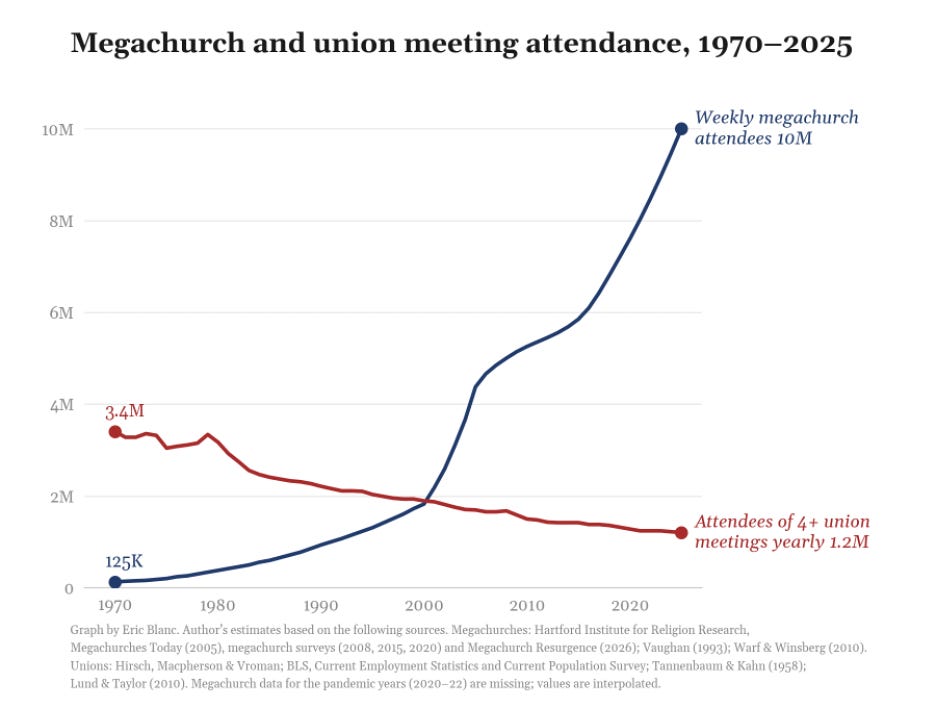
Roughly three decades ago, evangelicals like Warren systematized and scaled up organizing for our atomized era. The Left, by contrast, is still searching for a model. With a few partial exceptions, contemporary American liberals and radicals haven’t yet figured out how to build durable membership organizations capable of recruiting, retaining, and developing large numbers of people, beyond a small core of paid staff or self-selecting activists. We’re good at big moments like marches, viral campaigns, rallies, and the occasional electoral upset. We’re much worse at turning those moments into organizations that last—and grow.
Warren’s book is a field manual, born from relentless trial and error, full of specific tips about greeters, parking spots, name tags, surveys, and membership classes. “Like a research and development center, we’ve experimented with all kinds of approaches to reaching, teaching, training, and sending out God’s people,” Warren notes.
Of course, there are significant ideological differences between today’s evangelical churches and Left organizations. But what’s striking about Warren’s book is how familiar the problems are to our movements—and how useful his solutions are. Good labor and community organizers already use some of the following practices, but none of our organizations in the U.S. bring all of them together, much less as systematically as evangelicals. Those who doubt that we can replicate something like Warren’s systematic model need only look abroad to examples like the Belgian Workers’ Party, which has leaned on similar methods to build thick organization in our socially thin era.
Part 1 looks at what Warren teaches about recruitment. Part 2, which I’ll publish next week, turns to what happens once they’re inside the door: how to retain and develop members to build an increasingly robust organizing machine.
Here, then, are The Purpose Driven Church’s top 14 recruitment lessons for the Left.
1. Build the belonging that used to grow organically
Warren’s starting point was that the old social glue was gone. For generations, churches (like unions and political parties) could count on people showing up out of habit and social pressure, since neighborhood communities were so tightly knit. “Instead, membership is now an act of commitment,” he writes.
Organizing in hyper-sprawled Southern California, Warren saw that Americans had become mobile, lonely, isolated, and easily distracted by screens. “We’re experiencing an epidemic of loneliness in society,” he warns. But rather than simply mourn this, he spotted an opening: “This ‘longing for belonging’ provides the church with a timely opportunity. Positioning the church as an extended family, as ‘a place where you are cared for,’ will strike a sensitive chord in many lonely hearts.”
Evangelicals like Warren grasped the organizing consequences of community collapse long before the Left did. Much of the progressive movement and the Left still organize as if community already exists and just needs to be mobilized or represented. In today’s atomized conditions, Warren convincingly explains, belonging has to be built deliberately, by design.
2. Let people belong before they believe
Belonging before belief is one of the core strategic insights of the seeker-sensitive evangelical movement. Warren’s approach starts from a fishing metaphor. “If your church is serious about reaching the unchurched, you must be willing to put up with people who have a lot of problems. Fishing is often messy and smelly. Many churches want the fish they catch to be already scaled, gutted, cleaned, and cooked. That is why they never reach anyone.”
At Saddleback, newcomers were invited to “Come and see!” and weren’t expected to have their lives in order. “At Saddleback Church we do not expect unbelievers to act like believers until they are.” Warren would “rather have a southern California pagan attend our crowd service in shorts and a Budweiser® T-shirt than stay home or go to the beach.” He writes that he lost count of the unmarried couples who started attending while living together and then asked him to marry them once they converted; one pair had been living together for seventeen years.
Nor did Warren care much why people first walked in the door. “It doesn’t matter why people initially come to Jesus, what matters is that they come. He can work on their motives, values, and priorities once they enter his presence.”
While seeker-sensitive evangelicals let people belong before they believe, liberals and leftists tend to ask people to believe before they belong.
This has major organizational repercussions. Warren sets a low bar at the door and a high bar for membership at the same time. “We expect very little from the seeker who is investigating the claims of Christ. … On the other hand, we require a major commitment from those who want to join our church.”
Most of our organizations do the reverse. The bar at the door is high: you’re expected to know the right vocabulary and hold the right positions. Yet the bar for engagement is actually quite low: click a button, sign up for an email list, or, at most, pay modest dues. Nothing else is expected of you.
3. Study your terrain
Warren repeatedly warns readers not to copy him. “To artificially plant a Saddleback clone in a different environment is a formula for failure,” he writes. “Even I wouldn’t do everything we do at Saddleback if I were in another part of the country. You must figure out what works best to reach seekers in your local context.” It’s a method, not a formula.
Before holding a single service, Warren spent twelve weeks going door-to-door with five survey questions, starting with “What do you think is the greatest need in this area?” Reflecting on the responses he received to the question “If you were to look for a church to attend, what kind of things would you look for?” he recalls: “This single question taught me more about thinking like an unbeliever than my entire seminary training.”
What he heard became Saddleback’s blueprint. Locals said sermons were boring, members were cliquish, churches only wanted their money, and the childcare was bad. So Warren rebuilt his preaching, trained greeters, announced every week that visitors weren’t expected to give money, and published strict childcare guidelines.
Organizers know this as a listening campaign. The best unions do it before they pick their fights. But most activist groups decide their positions and messaging first, and only then go looking for an audience. Warren’s rule is blunt: “No book or demographic report can replace actually talking with the people in your community.” Asking questions is not just how you find out more; it’s also one of the best ways to get people to eventually open up to whatever you might have to offer. As Warren puts it, “I’ve learned that most people can’t hear until they’ve first been heard.”
4. Treat recruitment as a science
Unlike much of the Left, Warren realized that just being “right” would not automatically translate into effective recruitment. Getting people through the door had to be treated like a science, full of experiments, rigorous assessments, and readjustments.
Warren is refreshingly honest about how much failed. “The truth is, we’ve tried more things that didn’t work at Saddleback than did. We’ve never been afraid of failure; we just call everything an ‘experiment.’” He jokes that he could write another book called 1000 Ways to NOT Grow a Church.
The Purpose Driven Church is mercilessly critical of self-flattering metrics. Warren recalls a Peanuts cartoon in which Charlie Brown is practicing archery. “Instead of aiming at a target, he would shoot an arrow at his fence and then walk over and draw a target around wherever the arrow stuck.” Too many churches, he says, do the same: “We just draw a bull’s-eye around whomever we reach and settle for that.”
Nonprofits and Left organizations do this constantly. Instead of questioning our priors, we declare success no matter what, based on whoever happened to show up. And we often count activity (doors knocked, emails sent, events held) or political righteousness instead of results. Warren insists on judging growth relative to what’s ambitiously possible: “To be realistic, you need to focus on the percentage of population being reached, not the actual numbers.”
Above all, Warren refuses to let being correct serve as an excuse for being ineffective. He mocks congregations that treat their marginality as a badge of honor: “Some churches point to their lack of a crowd as proof that they are biblical, orthodox, or Spirit-filled.” Anyone who has spent time in small activist circles will recognize the type.
5. Win hearts, not just heads
Warren, a Southern Baptist preacher who believes in biblical truth, is emphatic that arguments aren’t what win people over. “More people are won to Christ by feeling God’s presence than by all of our apologetic arguments combined. Few people, if any, are converted to Christ on purely intellectual grounds.”
His biggest regret from his church’s early years was not taking this seriously enough. “In the first years of Saddleback, I made the mistake of underestimating the power of music so I minimized the use of music in our services.” Why does it matter so much? “A song can often touch people in a way that a sermon can’t. Music can bypass intellectual barriers and take the message straight to the heart.”
True to form, Warren figured out what music to play by asking people. He handed out 3x5 cards at a service and asked everyone to write down the call letters of the radio station they listened to. Saddleback soon stopped singing hymns in its services oriented to newcomers, and within a year attendance took off. The press took to calling it “the flock that likes to rock.” Warren admits the switch cost him hundreds of potential members, but he says it won thousands more.
“Too many church services resemble a funeral more than a festival,” he writes. On the Left, too many of our meetings resemble a graduate seminar or a wake. It wasn’t always this way: the labor and civil rights movements sang, socialized, and celebrated. Zohran’s campaign and NYC DSA soccer leagues have offered glimpses of that tradition’s revival. The challenge now is to make participatory joy the norm, not the exception.

6. Think like an outsider
“The problem is, the longer you are a believer, the less you think like an unbeliever.” Warren saw two reasons for this. First, insiders stop spending time with outsiders. “One of the greatest barriers to evangelism is that most believers spend all their time with other Christians. They don’t have any non-believing friends. If you don’t spend any time with unbelievers, you won’t understand what they’re thinking.” Second, they start talking in code. Of such pastors, Warren quips: “Every Sunday they speak in an unknown tongue without being charismatic!”
Warren warns against “developing such a close-knit fellowship that newcomers are afraid or unable to break into it.” He adds that “[t]he problem with most small churches is that they are all core and nothing else. The same fifty people come to everything the church does.” Whether in church or on the Left, tight bonds are good; tight bonds that nobody new can penetrate are fatal.
It’s easy for insiders to conclude that outsiders just aren’t interested, but what Warren saw in the survey results suggested otherwise. None of the complaints were theological, and he didn’t meet a single person who said they skipped church because they didn’t believe in God. “Most of the unchurched aren’t atheists: They are misinformed, turned off, or too busy.” His conclusion: “Churches need to stop saying people are closed to the Gospel and start finding out how to communicate on the unbeliever’s wavelength.”
All of this translates directly. Progressive and Left activists often have few apolitical friends, our rhetoric is thick with jargon, and when our efforts fall flat, we’re tempted to blame external conditions or the people we failed to reach. “They’re just not yet ready for our message,” we tell ourselves. “They’ll come around eventually.” But what if the problem is our less-than-effective organizing?
7. Orient to the unorganized
From day one, Warren focused on what we in the labor movement call organizing the unorganized. In his membership class, Warren told transfers from other churches bluntly that “if all you intend to do is attend services, we’d rather save your seat for someone who is an unbeliever.” Being a member of Saddleback meant you were expected to spread the gospel.
Ten days before Saddleback’s first Easter service in 1980, Warren and his tiny group hand-addressed and hand-stamped 15,000 invitation letters to local homes. The letter opened: “AT LAST! A new church designed for those who’ve given up on traditional church services!” It didn’t mention Jesus or the Bible, and this didn’t go over well with the faithful: “In fact, all of the critical and angry letters I received in response to this first letter came from Christians who questioned why I had not mentioned Jesus or the Bible.” Some even questioned whether Warren himself was saved.
But 205 people showed up for that first service, and eighty-two of them converted over the next ten weeks. Warren’s takeaway: “You have to decide who you want to impress.”
Leftists face the same choice, and we usually choose wrong. Progressive organizations and nonprofits spend much of their time building coalitions with other existing organizations, most of which are similarly small and/or staff-heavy. Socialist groups tend to orient toward the small existing milieus of the already radicalized, and we struggle to recruit broadly, in part because we’re so focused on looking over our left shoulder.
The overwhelming majority of Americans of all racial backgrounds remain unorganized. We have to decide whether our main concern is recruiting those millions or orienting to the thousands of existing leftists and nonprofits.
8. Love the people you’re trying to organize
For Warren, the most important ingredient in church growth isn’t a technique at all. “Loving unbelievers the way Jesus did is the most overlooked key to growing a church. Without his passion for the lost, we will be unwilling to make the sacrifices necessary to reach them.” Recalling what new converts told him had drawn them to Saddleback, Warren writes, “I’ve never had anyone say, ‘It was because of the Reformation theology you believe’ … Instead, the most common response was, ‘I felt an incredible spirit of love toward me that drew me in.’” The catch is that it’s easy to love those who already come week after week. “Of course, every congregation thinks their church is loving. That’s because the people who think it is unloving aren’t there!”
At Saddleback, love for unbelievers was measured above all in the consistent focus placed on bringing in new people. But it also took the form of small sacrifices made for newcomers. Members stood through packed services so visitors could sit. On cold days in the church’s tent, they offered visitors their coats.
Progressives and leftists often profess love for the marginalized and the working class in the abstract. Actual people, however, are another matter. Those who disagree with us too often face condescension or outright contempt. People can feel that from a mile away, just as Warren’s visitors could tell whether a church wanted them. In Warren’s words, “There is no method, no program, and no technology that can make up for a lack of love for unbelievers.”
The uncomfortable truth behind many nonprofits and socialist organizations is the one Warren saw in small churches: on some unconscious level, we don’t want a crowd—or at least we don’t want it enough to shake up our routines and assumptions. A tight circle of the already convinced is comfortable, as is being a big fish in a small sea.
9. Make every member a recruiter
For Warren, growth ran through members’ own relationships. “The fruit of a believer is another believer,” he writes. Saddleback needed advertising only at the start. “Today, with thousands of members inviting friends to our church, advertising is unnecessary.”
Warren offers a simple metric: a church should have at least 25 percent more regular attenders than members. If it doesn’t, “it means almost no one in your church is inviting unbelievers to come with them.” At Saddleback, twice as many people attended as were members. And if members don’t bring friends, that should worry leaders: “If most of our members never invite anyone to come to our church, what are they saying (by their actions) about the quality of what our church offers?” Very few liberal or Left groups even track whether their members are bringing anybody in.
Warren is just as clear about what doesn’t bring in newcomers: “By making members feel guilty for not inviting friends? No. By putting up a big sign that says ‘Visitors Welcome’? No. By cold-calling on homes in your community? Probably not.”
That last line should give us pause. Even a big success like Zohran’s campaign relied mostly on volunteers knocking on the doors of strangers, rather than recruiting their coworkers, neighbors, or fellow congregants. Knocking on strangers’ doors can win an election. It’s a much weaker way to build a deep, lasting organization.
10. Build a front door for newcomers
As a kid, Warren would sometimes bring non-Christian friends to his father’s church. Inevitably, that would be the Sunday his dad preached on tithing or a visiting missionary showed slides. Eventually he gave up inviting anyone: “I wouldn’t think of inviting my unchurched friends from the office because the service wouldn’t make any sense to them. The messages are for me, the songs are for me, the prayers are prayed in terms I understand, and even the announcements are for me.”
The root problem, Warren explains, is that “[i]n every church there is constant tension between the concepts of ‘service’ and ‘serve-us.’ Most churches end up tipping the scales toward meeting members’ needs because the members pay the bills.” His solution: “Create a service that is intentionally designed for your members to bring their friends to.” Saddleback’s weekend services were built for newcomers, while a separate midweek service fed the committed. He also urges churches to keep their internal business far away from visitors.
Many of our organizations don’t have a front door at all. There’s often no regular, in-person gathering designed for visitors, and very little serious onboarding. A newcomer’s first experience is often a digital mass call where they make no human connections, or a general meeting run for insiders: committee reports, points of order, or faction fights over resolutions they’ve never heard of. That’s a believers’ service, being used as a seeker service. No wonder that so many never come back—or that so few of our members are inclined to invite their friends, family, and neighbors to join in.
11. Engineer warmth, don’t assume it
Warren knew that warmth doesn’t happen by accident: “While some relationships will spontaneously develop, the friendship factor in assimilation is too crucial to leave to chance. You can’t just hope members will make friends in the church. You must encourage it, plan for it, structure for it, and facilitate it.”
So Saddleback engineered it. The best parking spots were reserved for visitors, and pastors and staff parked on the dirt. There were four distinct types of welcome ministers: parking attendants, greeters, hosts, and ushers. Greeters wore no badges, so newcomers would feel welcomed by friendly members rather than officials. Warren made flashcards to memorize names and knew everyone in his church by name until the church grew past about 3,000 people.
My favorite of Warren’s practices is the simplest. “In the early years of Saddleback, the members practiced what we called the ‘three-minute rule.’ We all agreed that for the first three minutes after the service was over, members would talk only to people they’d never met.”
And Saddleback measured whether it was working. Every first-time visitor got a postcard asking what they noticed first, liked best, and liked least. Nearly 90 percent said the first thing they noticed was the warmth and friendliness of the people. “That response is not an accident. It is the result of an intentional strategy to express love to visitors in a manner that they can comprehend.”
But a warm welcome at a big event is not enough for people to belong. Getting newcomers into small groups of about a dozen people that meet up weekly is what keeps them. At Saddleback, such groups brought members together, usually at someone’s home (and often with good food), to study the Bible, forge friendships, support one another, and work on shared projects. “We tell people, ‘You won’t really feel a part of this church family until you join a small group.’” And it paid off. “Small groups are the most effective way of closing the back door of your church. We never worry about losing people who are connected to a small group.”
12. Offer good news
“A lot of preaching is what I call ‘Ain’t it awful!’ preaching. It just complains about our society and makes judgments about people in general. It is long on diagnosis and short on remedy.” Sound familiar? Warren’s point is that people already know things are bad. “They are looking for solutions, not a scolding.” That’s why, he argues, “What people need today are fewer ‘ought-to’ sermons and more ‘how-to’ sermons.”
Much of the Left specializes in “Ain’t it awful!” politics: doom-posting, moralizing, and endless exposés of how terrible things are. Though diagnosis matters, people join organizations that offer hope and a practical path forward.
This positive vision also shapes how you motivate members. “Never use guilt or pressure to motivate people for ministry. It’s vision that motivates; guilt and pressure only discourage people.” The same goes for money. Warren notes that “people give to vision, not to need,” and concludes that “Churches with money problems often actually have a vision problem.” As Warren puts it, “People want to join a church that knows where it’s going.”
13. Repeat your most important points
Routine, repetition, and ritual are how we absorb important truths. Referencing the Book of Nehemiah, Warren coined what he calls the Nehemiah Principle: “Vision and purpose must be restated every twenty-six days to keep the church moving in the right direction.”
Saddleback repeated its five purposes everywhere: in every membership class, on banners and brochures, and in songs. They were even etched into the glass of the worship center’s foyer. Warren preached the same “state of the church” sermon every January, updating only the illustrations. “Don’t be afraid to repeat yourself, because nobody gets it the first time. I call repeating things over and over in fresh ways ‘creative redundancy.’” He also invested in catchy phrases like “Every member is a minister,” reasoning that “Slogans, maxims, mottoes, and pithy phrases are remembered long after sermons are forgotten.”
14. Build structures that last
Warren closes his recruitment case with a tale of two preachers. George Whitefield preached over 18,000 sermons, once addressed nearly 100,000 people near Glasgow, and helped spark the Great Awakening in the 1730s. But “Whitefield often left his converts without any organization so the results of his work were of short duration. Today, very few Christians would recognize George Whitefield’s name.” John Wesley preached to huge crowds, too. “But Wesley was also an organizer. He created an organizational structure to fulfill his purpose that far outlasted his lifetime.” That structure is called the Methodist church.
The lesson: “For any renewal to last in a church, there must be a structure to nurture and support it.”
The American Left has been in its Whitefield era for a generation. Since the giant protests against the Iraq War in 2003, we’ve seen one ephemeral explosion after another: the immigrant rights marches of 2006, Occupy, the Women’s March, the 2020 uprising after George Floyd’s murder. Each drew millions. Few built or strengthened lasting institutional power.
Warren saw where that road leads. “If you don’t have a system and a structure to assimilate and keep the people you reach, they won’t stay with your church. You’ll have as many people going out the back door of your church as are coming in the front door.”
The deeper lesson is that recruitment is not a one-way funnel but a cycle: recruit, assimilate, develop, deploy, recruit again. The people who come through the front door have to be absorbed into relationships, developed into committed members, and given meaningful work. Then they become the people bringing in and building the next wave. That’s how to turn growth into self-sustaining growth. And it’s where Part 2—on developing an organizing machine—begins.
[Co-published with What’s Going On?]
Life is lived in cycles. This is the daily and seasonal rhythm we all experience, and yet generally the Left plans in a strait line. A welcoming Church provides just such a cycle and we would do well to learn from it.