

Why have only four national unions publicly backed Chris Van Hollen against Chuck Schumer for Senate leader? Good on the Machinists, the Office and Professional Employees International Union, National Nurses United, and the National Union of Healthcare Workers for taking the right side in this urgent fight. But where is everybody else?
It’s hard to overstate the stakes. If Democrats once again squander the opportunity given to them by the American people, the lost chance to improve people’s lives—and the ensuing political backlash—could be even worse than what followed the Clinton, Obama, and Biden administrations. Schumer-style corporate politics might as well have been designed in a lab to ensure that Democrats disappoint voters and quickly hand Republicans back the reins of power, perhaps this time under an even more dangerous and effective incarnation of far-right reaction.

Missing the Moment
There is exactly zero reason to believe Schumer is the man for this moment. He’s a pro-Israel war hawk who is deeply embedded with the same billionaires that Democrats—including every single victorious 2026 Democratic Senate candidate in a battleground state—ran against in these midterms.
Want to see the PRO Act and other urgent reforms passed within the first 100 days of the next Democratic administration? So do I. But even if Democrats win the presidency and retain Congress, getting this crucial labor-law reform enacted will almost certainly require abolishing the filibuster. Van Hollen has explicitly endorsed doing so. As he put it last Friday, the Senate needs to let majorities govern with “51 votes,” rather than keeping the “anti-democratic” filibuster. Wall Street Schumer, by contrast, has refused to say whether he’d support getting rid of it. Asked directly after the midterms whether Democrats should abolish the rule, he dodged the question.
There’s also plenty a Senate majority leader can do over the next two years, even with Trump still holding the presidential veto. Democrats should aggressively investigate the administration’s corruption and use their control over spending to immediately challenge its worst policies on Iran, ICE, and Israel. Even more important, they’ll need to make it crystal clear to Americans the ambitious agenda they’ll enact if they win the White House in 2028. Van Hollen is promising to make the Senate a center of political opposition to billionaire power, putting popular reforms on the table and forcing Republicans to defend their opposition. Schumer is itching to return to the familiar routines of Schumerism: decent policy promises, timid negotiations, and endless excuses for inaction.
Plus, he’s insanely unpopular. A November YouGov poll found that just 23 percent of voters viewed Schumer favorably, compared with 39 percent for Trump. That’s right, the Democratic leader most national unions are so far refusing to buck is substantially less popular than Donald Trump. An astonishing 57 percent of voters view Schumer unfavorably. Only 10 percent want him to remain Senate majority leader, compared with 57 percent who want somebody else.
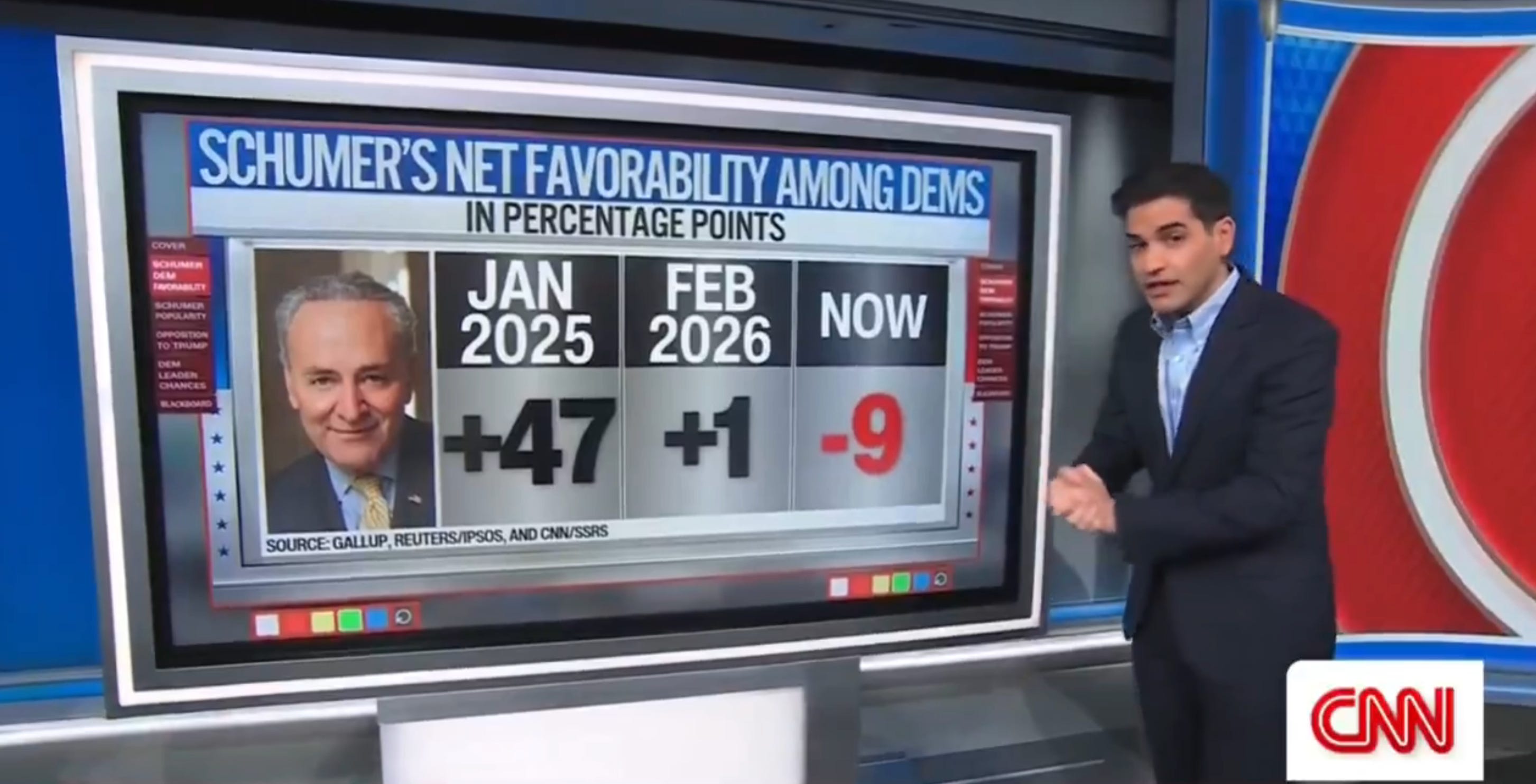
Why on earth should the party’s future be placed in the hands of someone so widely disliked?
Schumer’s supporters understandably point to the Democratic victories this month. He did help recruit some good candidates, and that deserves some credit. But winning a midterm election amid an unpopular president’s economic and political disasters is a pretty different task from governing successfully afterward.
The Case for Van Hollen
Like FDR in the 1930s, Van Hollen comes out of the Democratic establishment but is reading the mood of the public and offering a real alternative to politics as usual. He has called for confronting billionaire power, backed Medicare for All, supported ending the filibuster, and taken a much tougher line on using congressional spending authority to end Trump’s war with Iran. He has also pledged to give the new class of insurgent populist senators a greater role in shaping the party’s direction.
Obviously, changing the leader won’t automatically overcome every obstacle to reform. Obviously, switching Senate leaders doesn’t mean the rest of us can sit back and watch the Democrats finally deliver. But there’s a big difference between a leader promising to break with business as usual and one whose career has largely been built around it.
Van Hollen has also shown that he’s willing to take political risks for workers. Don’t forget the case of Kilmar Ábrego García, the SMART sheet-metal apprentice whom Trump illegally deported to a notorious prison in El Salvador. Van Hollen personally flew there, met with Ábrego García, and helped lead the fight that brought him back to the United States. Where is SMART in this leadership fight?
Thankfully, some national unions have so far made clear that they understand the stakes. The Machinists’ president, Brian Bryant, said Van Hollen understood that the fight was one of “Workers vs. Billionaires.” OPEIU likewise sent Schumer a letter urging him to withdraw and make way for another leader, such as Van Hollen. National Nurses United put the point well in endorsing Van Hollen. Its executive director, Puneet Maharaj, warned that Democrats must not squander the opening voters have given them.
Politicking on the K Street Corridor
The reason why more national union leaders aren’t yet saying the same isn’t complicated. Many of them feel that a significant part of their job is to build close relationships with congresspeople to deliver for their members and fight for pro-worker legislation. If they back Van Hollen and Schumer wins, there’s a real risk that their union might suddenly find that their calls get returned a little less quickly (or not at all), and that important Democratic leaders might no longer listen to their legislative priorities. That’s a valid concern, especially given how Washington currently works.
But it’s also an extraordinarily narrow way to calculate political risk, especially at this moment of crisis in U.S. history. For years now, progressive union leaders have rightly insisted that democracy is on the line, that sky-high economic inequality must be reversed, that the Democrats should stand up for the little guy, and that the labor movement must do everything possible to defeat MAGA and greedy CEOs.
Now union leaders and Democrats have a rare opportunity to actually move the needle in that direction. And it doesn’t even take much effort. This Senate fight is one of those exceedingly rare moments when a union press release could make a historic difference for working people and the country as a whole.
There’s no excuse for silence. Schumer is 75 and faces reelection in 2028—if he even chooses to run. He’s hardly a permanent fixture of American politics. And Van Hollen is a respected senator who can work across the party’s ideological divisions.
The timidity prevailing on the K Street corridor of downtown D.C. isn’t an inevitable way of doing politics. Just look at how much bolder unions have been in state-level contests this year. In Michigan, the UAW, AFT Michigan, National Nurses United, the flight attendants’ union AFA, and UFCW Local 951 were among the unions that took sides in a fiercely contested Democratic Senate primary, backing Abdul El-Sayed against Schumer’s preferred candidate, Haley Stevens. In Maine, the state AFL-CIO and dozens of local unions went all out for Troy Jackson. And in Minnesota, SEIU, UNITE HERE Local 17, and others backed Peggy Flanagan against the more establishment-friendly Angie Craig. All three of these Senate winners are now supporting Van Hollen.
Moving away from this bold spirit, most national union leaders currently appear to want to stay silent, hoping to square the circle between the evident anger of their base and their desire not to break with Schumer.
Some of them have framed the issue to me over the past few days as a matter of fighting for the agenda, not the person. But whether they like it or not, it’s precisely that choice of agenda and strategy that’s now being posed by the Senate leadership fight. Everybody knows that who leads the party has a great deal to do with what the party actually does.
It’s a bit disingenuous, too, to suddenly insist that the agenda matters but the leadership doesn’t, given how many national unions came out swinging for Nancy Pelosi when her speakership seemed like it might be challenged in 2018. Back then, the AFL-CIO, AFT, AFSCME, SEIU, UAW, Steelworkers, and numerous other unions publicly backed Pelosi in her fight to return as House speaker. Union leaders understand that the choice of congressional leadership matters for the legislative agenda.
Not Too Late
My suggestion to rank-and-file members and local and state union leaders is to look at this Van Hollen-Schumer fight as a test of whether their national leaders are ready to meet the moment. If they’re not able to take even this relatively mild risk to help save the Democrats from themselves, why should we expect them to take on the much bigger, even more consequential risks, like backing anti-corporate candidates for office in 2028 or massively investing in new organizing to unionize America afterwards?
National union leaders still sitting this out or leaning toward Schumer should reconsider. And the rest of us shouldn’t be afraid to raise a little hell. You can write to or call your national union leaders, asking them to do the right thing. You can introduce resolutions at local meetings calling for support for new Senate leadership. And make sure to do so soon, while there’s still time to influence the December 1 leadership vote.
In today’s fight for the future of the Democratic Party, national unions have to choose a side. They can stick with the old, corporate-friendly hacks that helped get us into this mess, or stand with those willing to fight against business as usual. There’s no neutral ground here. The fight over the Senate leadership poses the question particularly sharply: Which side are you on?
The only thing I'd add is that you don't need to just rely on your national union. If your Local (or District Council, etc) is in a state with Dem Senator(s), you can call on your Local to push your Senator(s) to commit to vote for Van Hollen. Even if Schumer wins, putting your state's Dem Senator(s) on notice will be a worthwhile activity.
Also, I don't know about others, but my experience of moving national unions has very much run through pushing their Locals to be more active. Some big Locals in blue states moving on their Senators is likely to catch the IU's attention.