

Within hours of last Tuesday’s shellacking of Republicans, the centrist think tank Third Way was claiming credit. Its November 4 memo, “Moderates Made Democratic Majorities,” declared that “the majority makers of 2026 were mainstream and moderate Democrats” and pointed to victories in Texas, South Carolina, Iowa, and Kansas as proof that the party should move toward the “center.” Meanwhile, the wins of left-wing candidates like Abdul El-Sayed in Michigan and Troy Jackson in Maine were treated as cautionary tales.
Our friends at Third Way are either confused or lying, because the evidence is clear: Bernie Sanders’s anti-billionaire message was widely adopted by Democrats in this election, including among the very candidates Third Way celebrates as “moderates.”
I spent the past week combing Democratic Senate campaign websites from 2024 and 2026 to quantify Democrats’ shift to economic populist rhetoric. The results were even more dramatic than I expected.
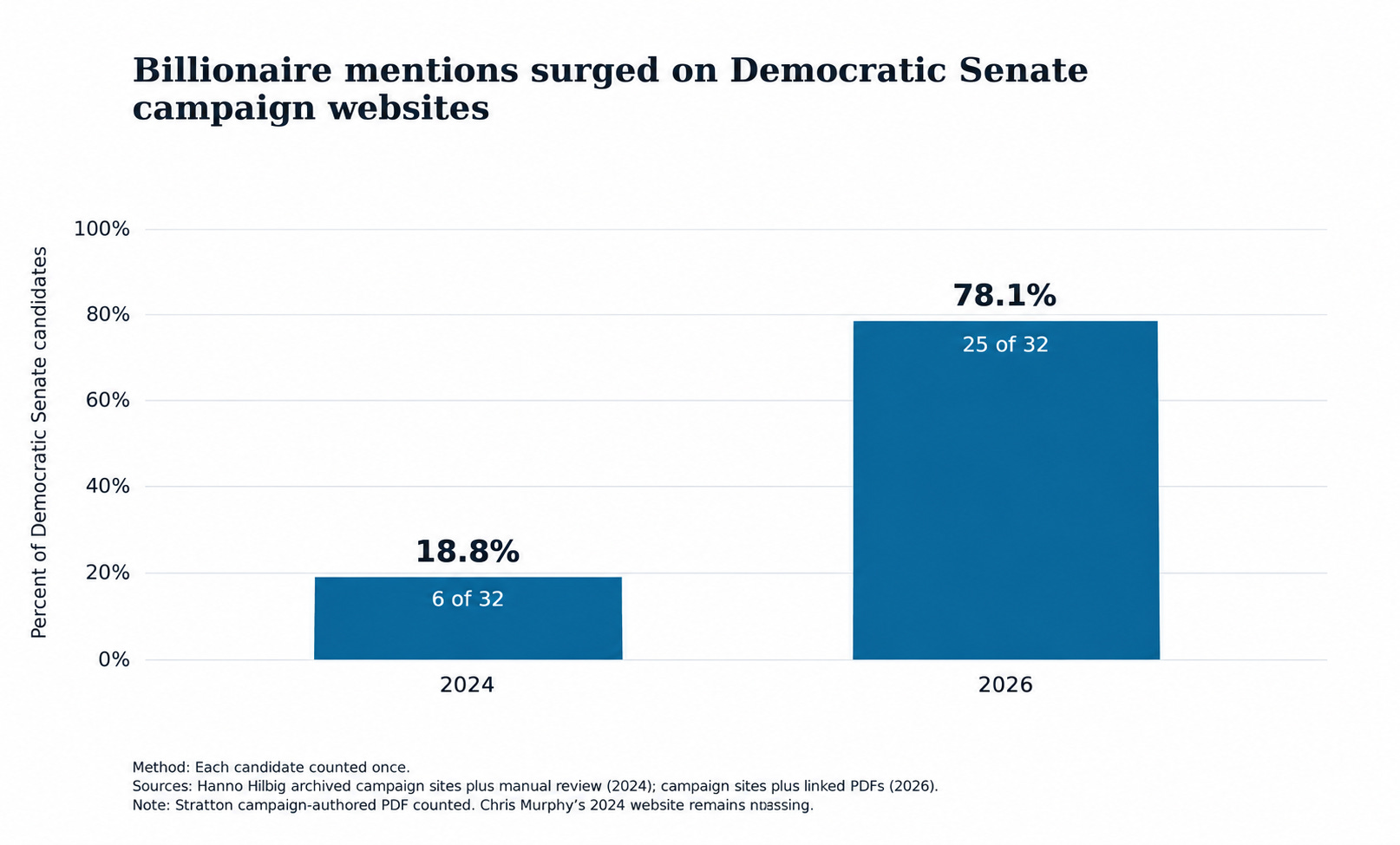
In 2024, “billionaire” or “billionaires” were referenced on six of 32 Democratic Senate campaign websites — only 19 percent. In 2026, the figure was 25 of 32 — a whopping 78 percent.
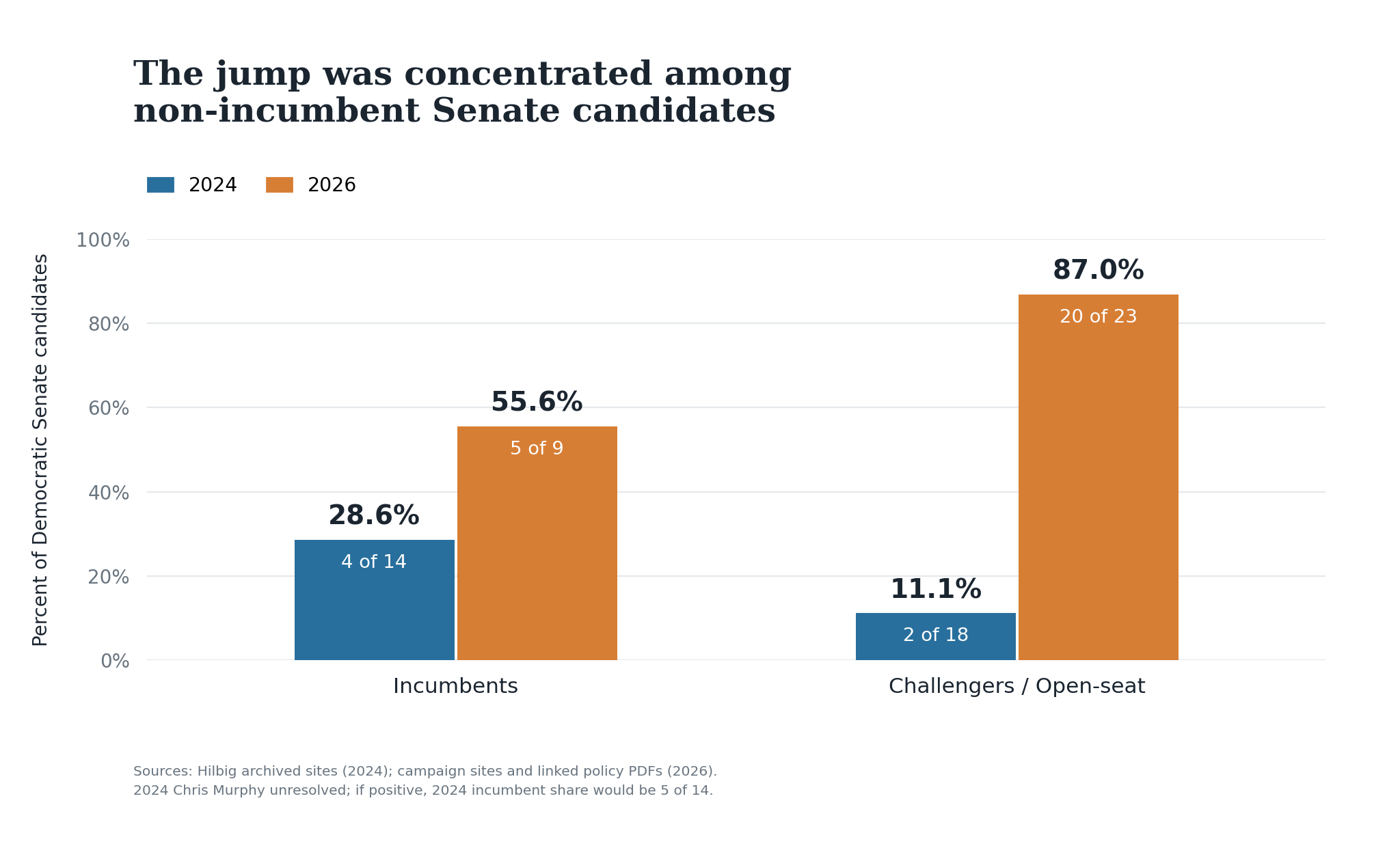
The change was greatest among challengers and open-seat candidates. In 2024, only two of 18 had websites mentioning billionaires, or 11 percent. Two years later, 20 of 23 did, or 87 percent. Among incumbents, the figure also rose, from 29 to 56 percent.
Compare this year’s campaigning with the Democrats’ more conventional economic messaging in 2024. Last time around, Washington Senator Maria Cantwell’s website praised the state’s successful businesses and her work supporting its “unique and enviable culture of science, innovation, and economic growth.” As Democrats have done for decades, she called for shared prosperity, without identifying the social class blocking this.
Several of the biggest 2026 winners were far more confrontational. Their attacks on the wealthy were prominent campaign themes, rather than passing references buried in a press release.
Take James Talarico, the Texas senator-elect frequently hailed as a model for Democratic moderation. On the campaign trail, he denounced Democrats and Republicans alike for embracing “trickle-down economics” for close to half a century. And in his victory speech, he accused billionaires who control media and politics of keeping Americans divided while the wealthy enrich themselves. “The real fight in this country is not left versus right,” he declared. “It is top versus bottom.”
Texas’s new Democratic governor, Gina Hinojosa, offered an equally direct argument. Her campaign asked: “Does Texas belong to the people of Texas, or is this the billionaires’ world and we just live in it?” In her victory speech, she promised an end to writing separate rules for working families and the wealthy.
In South Carolina, Senator-elect Annie Andrews made the point in an election-night message pinned to her Twitter account. Voters had shown, she said, that even in “a politics dominated by billionaires, special interests, and insiders in Washington,” they would not bow down. Andrews campaigned on healthcare and affordability, while refusing to treat big-money influence as an unavoidable fact of political life.
Nor were these isolated examples. Of the eleven victorious Democratic Senate challengers and open-seat candidates, all had websites mentioning billionaires: Talarico, Andrews, Josh Turek in Iowa, Adam Hamilton in Kansas, Roy Cooper in North Carolina, Sherrod Brown in Ohio, Chris Pappas in New Hampshire, Peggy Flanagan in Minnesota, Juliana Stratton in Illinois, Abdul El-Sayed in Michigan, and Troy Jackson in Maine.
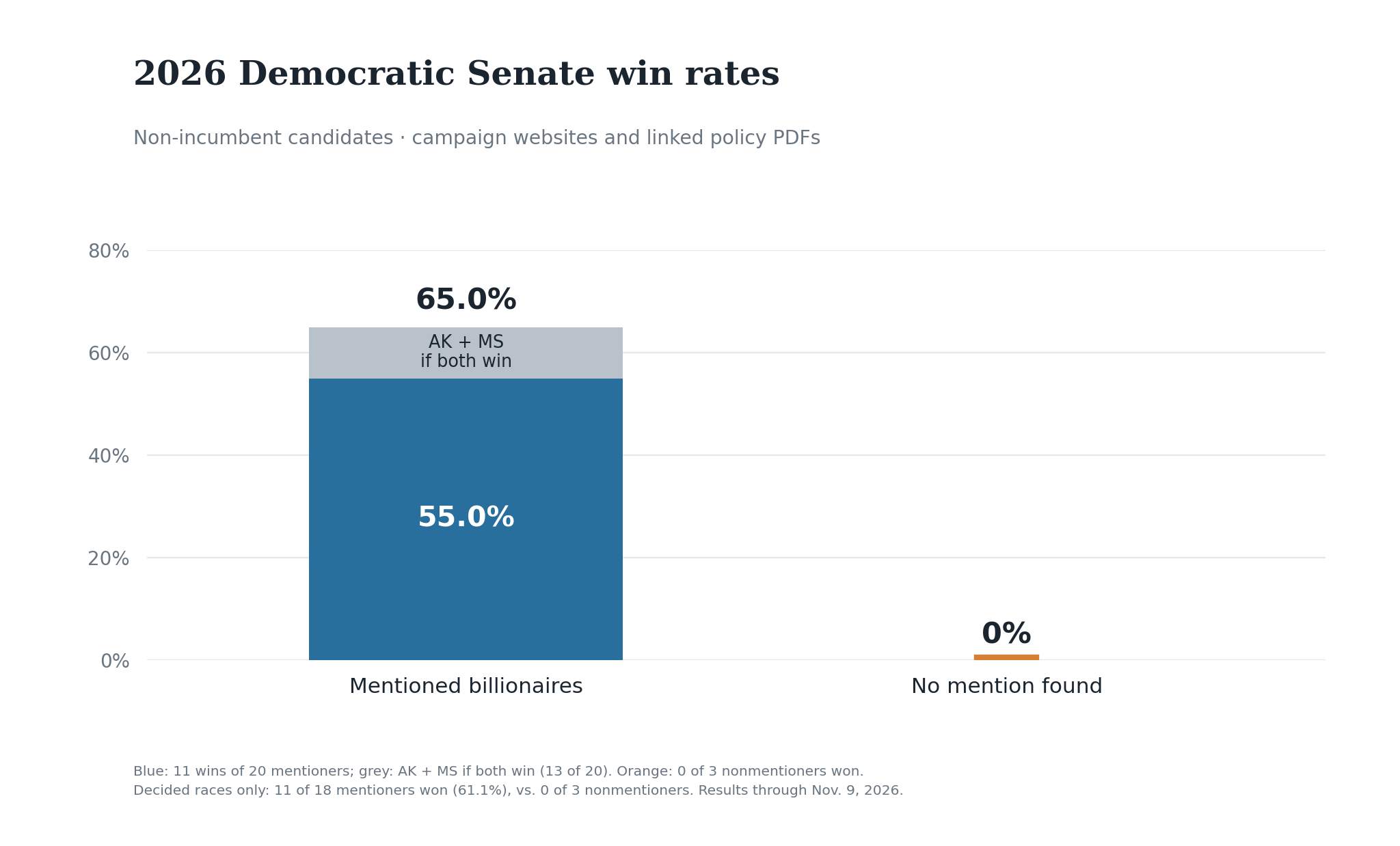
Democratic Senate candidates who ran on anti-billionaire messaging were spread out all across the country, and they won more frequently than candidates without documented mentions. Among the 20 non-incumbent Democrats whose campaign websites or linked policy documents mentioned billionaires, eleven had won and seven had lost, with Alaska and Mississippi still unresolved but Democrats leading in both. All three candidates without a documented mention had lost. Among decided races, that was an 11-of-18 win rate (61 percent), versus zero of three.
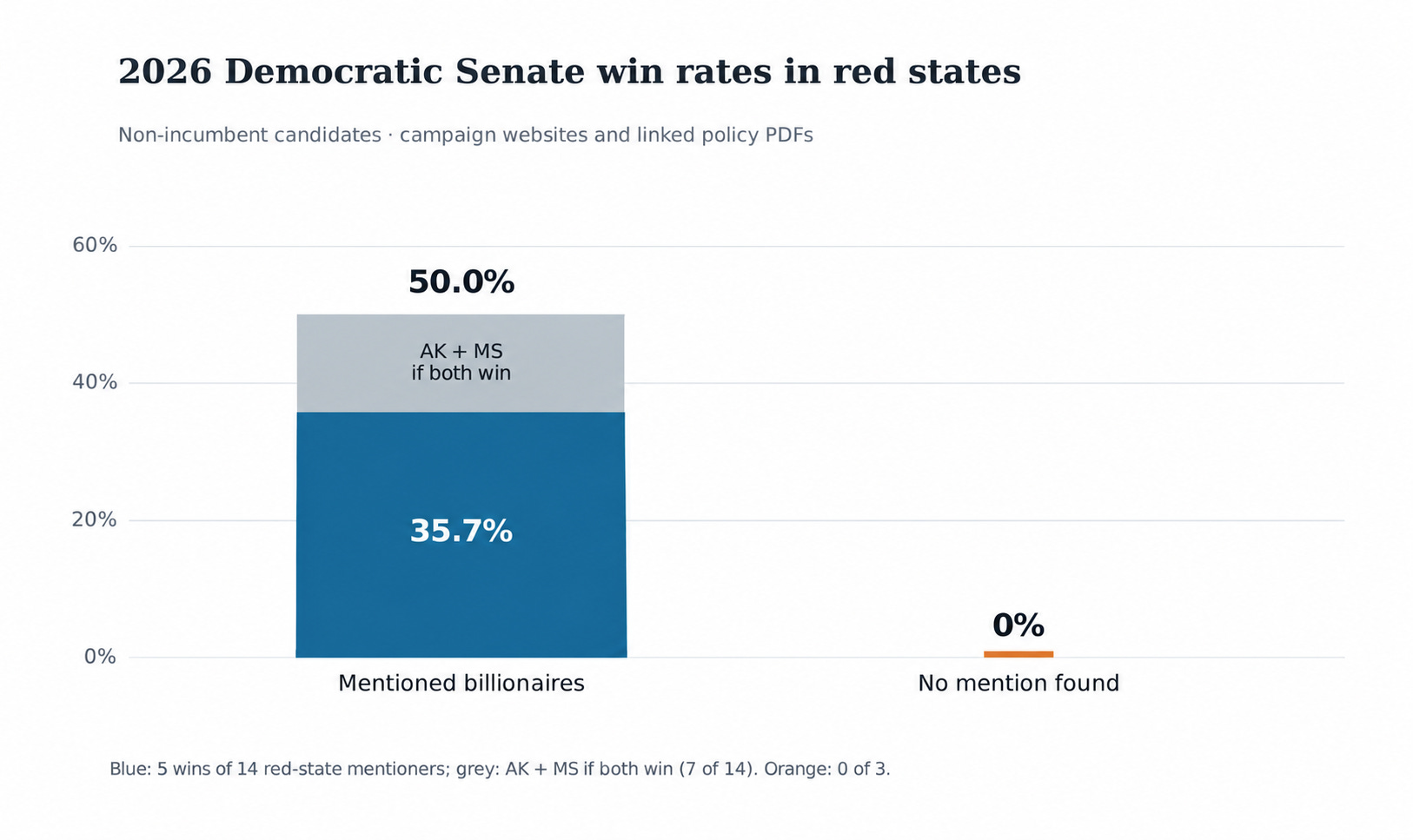
The pattern persisted in states Trump carried in 2024. Five of the twelve billionaire-mentioning candidates with decided races won, while all three candidates without documented mentions lost.
To be sure, these win rates are descriptive rather than causal: the samples are small, the contexts differ, and website mentions of billionaires aren’t a complete measure of a candidate’s economic platform (or of their willingness to challenge economic elites once in office). Nor can they prove that attacking the one percent caused anyone to win.
It’s obvious that a powerful anti-Trump backlash was the main driver of the Democratic wave. But my findings do establish that candidates using this economic populist language won across the country, including in states where Democrats had struggled for decades and where Third Way-type consultants wrongly still insist that across-the-board moderation is the only possible path to victory.
A politician can sound like a centrist on some cultural issues while calling for a fight against the billionaire class. That distinction matters if we want to understand what Democrats actually ran on this time around. Some successful Democrats took positions on immigration or trans rights to the right of the party’s progressive wing. But none of that prevented them from running against wealthy donors, corporate interests, or the rules of an economy tilted toward the rich.
Third Way acknowledges that winning Democrats campaigned on lowering costs. But, in addition to obfuscating Zohran Mamdani’s role in bringing this message to the fore, its ideological categories obscure whom these candidates blamed for the problem.
In one sense, the fact that politicians like Talarico and Andrews are now being called “moderates” is itself a victory for economic populism. After Sanders helped make the billionaire class a familiar political target, and after virtually the entire corporate elite cozied up to Trump 2.0, ideas once dismissed as too radical for ordinary voters have become standard campaign language among Democrats of all stripes. That’s what winning the argument looks like.
Yet this lesson can easily be lost if establishment pundits and politicians distort the mandate delivered last Tuesday. It would be a disaster for Democrats to forget the economic commitments their candidates made during the biggest Republican rout in five decades. To actually deliver healthcare, childcare, and housing, Democrats need to take on the handful of oligarchs who benefit from the status quo.
Last Tuesday offers no proof that anti-billionaire rhetoric alone wins races. But it offers plenty of proof that such rhetoric is compatible with victory from Texas to South Carolina to Iowa and Kansas. Corporate donors and their defenders would prefer to make this lesson disappear. We can’t afford to let them.
This article was first published today in The Nation here, please share widely!