

[An earlier version of this article painted a one-sidedly negative picture of the Working Families Party and a one-sidedly positive picture of NYC-DSA’s advance in working-class communities. Thanks to comrades who reached out with criticisms; the much-updated version below strikes me as more well-rounded and more strategically useful. ]
Tuesday’s election made clear the limitations — strategically and organizationally — of New York City’s labor leaders.
In the city’s two marquee congressional primaries, candidates backed by labor’s biggest names — 32BJ, 1199SEIU, DC37, the Hotel and Gaming Trades Council, the United Federation of Teachers, and others — went down to defeat. In the first, Congressional Hispanic Caucus chair Adriano Espaillat, a corporate Democrat who racked up some fourteen union endorsements, lost his Upper Manhattan and Bronx seat to Darializa Avila Chevalier, a thirty-two-year-old democratic socialist insurgent backed by Zohran Mamdani, the New York City Democratic Socialists of America (NYC-DSA), and Justice Democrats.
Delivering Avila Chevalier the biggest Congressional upset since Alexandria Ocasio-Cortez’s win in 2018, a majority of District 13 primary voters showed that they no longer trust a Democratic establishment unable or unwilling to seriously challenge Trump and an oligarchic status quo. Yet most union leaders haven’t yet followed their lead. And it’s a sign of serious internal decay that these organizations, so powerful on paper, can now deliver so little in the way of actual votes. Far too often, union members have become disconnected from our organizations.
We saw this same movie play out in early 2025, when most of the city’s union leadership lined up behind Andrew Cuomo — a serial harasser they’d demanded resign four years earlier — and watched Mamdani beat him anyway. (And in another, no less troubling form, we’ve seen how many unions across the country have struggled to convince their members to vote against Trump.)
Faced with an era of crisis and anger at the status quo, voters of all backgrounds are increasingly tired of old-guard politics, particularly in its corporate Democratic variety. It’s hard to take seriously the shallow identity-based appeals of establishment leaders like Espaillat when they are all too eager to cash donor checks from the real estate interests responsible for pushing working-class communities of color out of the city.
Union leaders need to come to terms with the fact that backing old-guard politicians like Espaillat or Cuomo is no longer a risk-averse, pragmatic wager. Even on purely self-interested grounds, savvy union operators should start reading the room. With a possible Alexandria Ocasio-Cortez presidential run looming, the stakes are high.
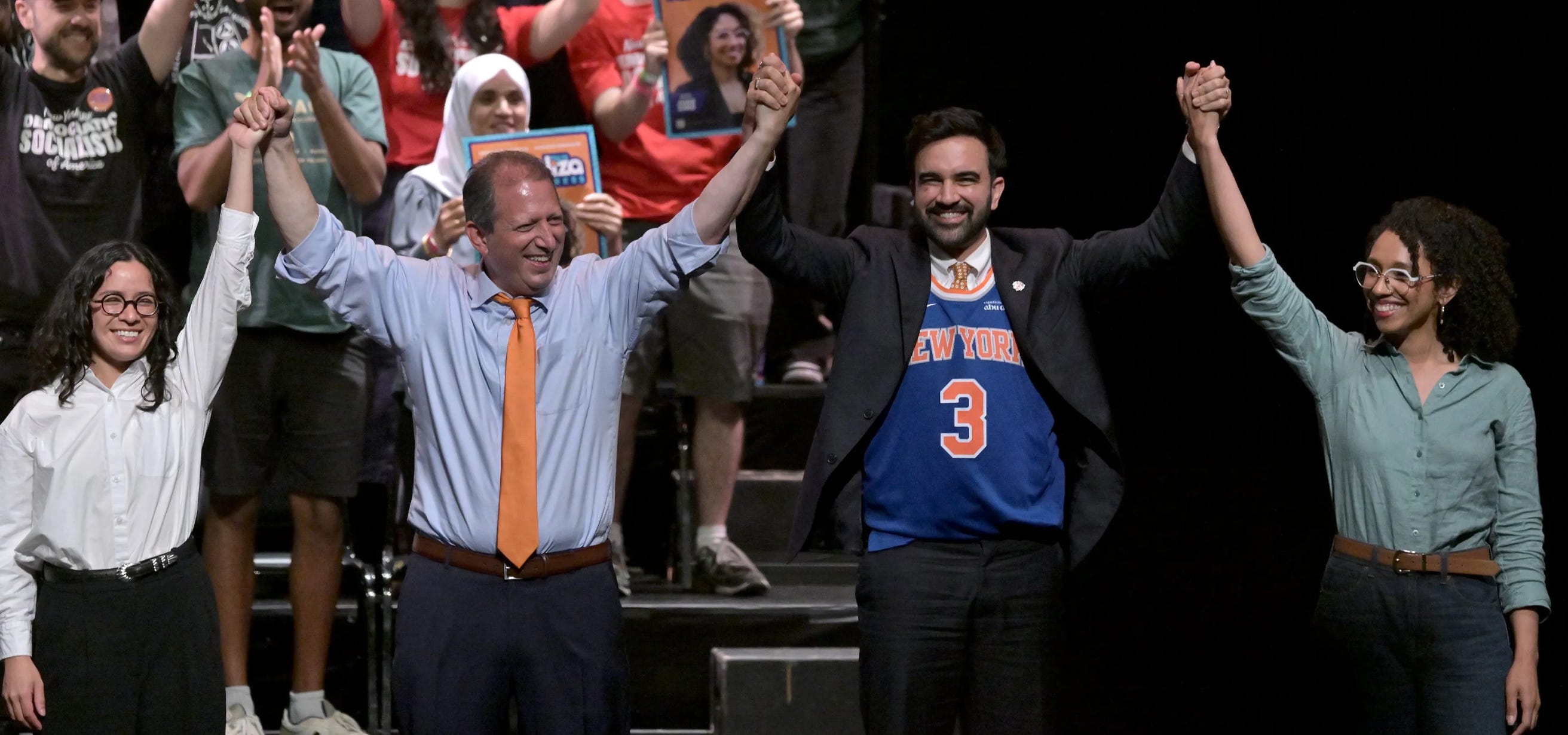
The race in Brooklyn’s District 7 was also significant, though for different reasons. It was a battle for the senior partner of New York City left politics, with the race pitting Brooklyn borough president Antonio Reynoso — a genuine progressive backed by a nearly identical union roster, the Working Families Party (WFP), and the city’s main progressive non-profits — against union activist and DSA cadre Claire Valdez. Unlike with Espaillat, this was a race between two anti-establishment candidates, whose immediate programs are not too far apart. And very much to its credit, the WFP played a central role in Tuesday’s exciting ousting of centrist incumbent Dan Goldman by Zohran-backed progressive Brad Lander; no less noteworthy, the WFP last year built a broad an anti-Cuomo alliance and eventually endorsed Zohran #1 in the ranked–choice primary.
But District 7 was an important test case for the relative strength of DSA’s organized base versus that of non-profits, the WFP, and allied unions. Once the results were tallied, DSA came out on top in a surprisingly decisive victory: Valdez swamped Reynoso 56 percent to 36 percent.
That’s a very good thing, because having a democratic socialist cadre like Valdez in Congress opens up important new opportunities for going on the offensive against the Democratic establishment and for recruiting large numbers of people nationwide into a radical, democratic membership organization like DSA. While progressives and socialists should always search for ways to collaborate, the weakness of the latter has for decades been a particularly crucial obstacle to transforming the Democratic Party and organized labor.
Only a tiny handful of unions had the political courage and conviction to stand up for Valdez’s bold vision of transformational change. United Auto Workers (UAW) Region 9A, led by director Brandon Mancilla, should be commended for fighting so hard for both Valdez and Avila Chevalier. As UAW president Shawn Fain put it at Valdez’s January 9 campaign launch event: “This is exactly how the labor movement can fight back against corporate greed and inequality: by electing more of our own.” (Claire was also endorsed by IFPTE and AFGE as well as by the left-led, South-Asian non-profit DRUM Beats.)
And while Tuesday’s election results are exciting for democratic socialists, it’s important to be sober about the still-serious challenges and limitations facing us. While Tuesday shows that large numbers of working people are now willing to vote for our candidates, DSA’s electoral base — and especially our activist base — remains disproportionately college educated and young. In New York, as in the country as a whole, education and generational polarization remain the most important divides within the left-of-center coalition.
It’s important to push back when union and non-profit leaders claim to be the only legitimate political spokespeople for the multiracial working class; if that were true, Tuesday’s elections would not have gone the way they did. But we should all be honest: none of our organizations, from the unions to the non-profits to DSA, are anywhere close to being as deeply rooted in the class as we need to (or aspire to) be. After five decades of neoliberal atomization, union busting, and the fraying of working people’s social fabric, this should be no great surprise. Structural obstacles like these are not easily or quickly overcome.
It’s true that Zohran and democratic socialist ideas are very popular. And it’s true that DSA meetings (especially over the past 18 months) are much more racially diverse than smears against us would suggest. But democratic socialism’s organized roots in workplaces and working-class neighborhoods do remain alarmingly thin. Getting votes and building sustainable on-the-ground power are not the same thing.
The big upshot from Tuesday’s election is that all progressives and leftists need to be far more ambitious about going out and organizing working people of all backgrounds. For NYC-DSA in the Zohran era, the openings for recruiting and developing large numbers of young black and Latino New Yorkers are immense, but we’ll have to make a serious turn towards building an organizing culture better capable of absorbing and developing new leaders beyond the self-selecting activist types who normally join. (Learning from the organizational methods of mega-churches would be one useful place to start.)
The relative narrowness of all our organized bases also means that DSA, non-profits, unions, and the WFP can’t afford to get stuck in narrow faction fights or turf wars. Since it’ll take all of us to overcome our corporate enemies and their political enablers, we can’t let our strategic differences prevent us from uniting tactically on campaigns we can agree on, whether in electoral politics or on policy fights. As I wrote in an article written exactly one year ago about Zohran’s victory in the mayoral primary:
It took a liberal-Left alliance to defeat Cuomo. A huge amount of credit is due to Brad Lander for being a man of principle who refused to punch Left. At the same time, Zohran smartly rejected a widespread leftist tendency to treat liberals and liberalism only as ideological competitors to be fought. Look at how he adopted the best parts of the “abundance agenda,” how he cross-endorsed Lander, and how he framed his criticisms of Israel in the language of liberal equal rights. Leftists can’t defeat the old establishment — let alone overcome the Right — on their own. And mutuality cuts both ways: we can’t ally with liberals only when we’re in the lead.
That being said, there are strong moral and political reasons why unions, progressive non-profits, and the WFP should try to be bolder electorally and more collaborative when it comes to DSA. Only transformative working-class politics can deliver the type of change working people desperately need and, in so doing, provide a viable alternative to Trumpism. Working people are angry and the old establishment is discredited. Now is a moment for raised expectations and bold initiatives, not business as usual or narrow maneuvers to protect one’s organizational turf.
Tuesday’s election shows that voters are hungry for change. It’s time we get organized together to deliver it.
More
As mentioned above, this is a significantly revised version of an earlier, way-too-polemical and way-too-quickly-written assessment of Tuesday’s election. When it comes to debate within the movement, it’s always better to err on the side of political generosity; politics is hard, and none of us have all the answers to what it’ll take to win. I already knew this, but making this week’s mistake was a useful reminder. Mea culpa.
Please, as always, share this post widely! THANK YOU.
If you’re not a member of DSA yet, what are you waiting for? Join here.
My output for Labor Politics is going to be a bit less frequent than normal for the next year—expect about one post a month. I have a good excuse: in addition to helping set up a new student to labor pipeline, I’m deep into a new book project on what we can learn from evangelicals about organizing and community building. I just spent a fascinating week embedded in a multiracial, Trump-leaning mega-church in the Midwest; can’t wait to share with you all these stories and lessons. We’re so far behind evangelical churches when it comes to building mass belonging, developing leaders, and recruiting working people via music, ritual, community, and big ideas that give life purpose and meaning. Lots more to come.
Excellent post. The old guard is crumbling and finally for good reason. It’s time for unions to get on board or get out of the way.
One more thought. I’m incredibly happy at what DSA was able to accomplish, but to say that WFP and labor groups essentially need to get down or get run over is ridiculous. Besides the fact that WFP has been in this fight for much longer and has proven consistently to be about the right things. The DSA does not have enough power to defeat all of the institutions we face. If we want a better world it will take a broad coalition. We need each other.