

Democratic Socialists of America (DSA) has been in the press a ton recently. Most of it has been remarkably positive, but there’ve also been some viral clips that have helped the Democratic and Republican establishments try to undermine our movement. We don’t often get openings like this to speak directly to tens of millions of Americans, so it’s crucial we make the most of them. To discuss these issues and how DSA can truly seize the moment, I went on WNYC’s Brian Lehrer Show this morning. The interview transcript has been lightly edited.
Brian Lehrer: Even as DSA politicians like Zohran Mamdani, Alexandria Ocasio-Cortez, and others rise in prominence and influence, the DSA is engaged in determining exactly what it wants to be as it tries to actually win elections — and then to actually govern, rather than just be a kind of left-wing think tank or activist group. The New York Times this month had a story about the DSA National Summit in Chicago, where members debated whether socialist candidates should be free to distance themselves from goals like abolishing prisons as they chase more seats this fall. And maybe you’ve heard this 45-second clip of DSA National Co-Chair Megan Romer, being widely shared on social media after her appearance on Fox.
Shannon Bream (Fox, in clip): We’re going to put up on the screen a few of the things that are part of your platform, and I want to ask you to just give me sort of a true/false on these. Abolish the Senate.
Megan Romer (in clip): True.
Bream: Okay. Replace the presidency and Supreme Court as we now know them.
Romer: Yep.
Bream: Abolish ICE.
Romer: Absolutely.
Bream: Abolish borders and give amnesty to anyone currently in the U.S. illegally.
Romer: As a long-term plan, yep.
Bream: Defund the Pentagon.
Romer: Absolutely.
Bream: Abolish prisons, at least in large part.
Romer: Yeah — again, as part of a long-term program.
Bream: Okay, so no prisons. Government or public ownership of most large corporations.
Romer: Yeah, absolutely.
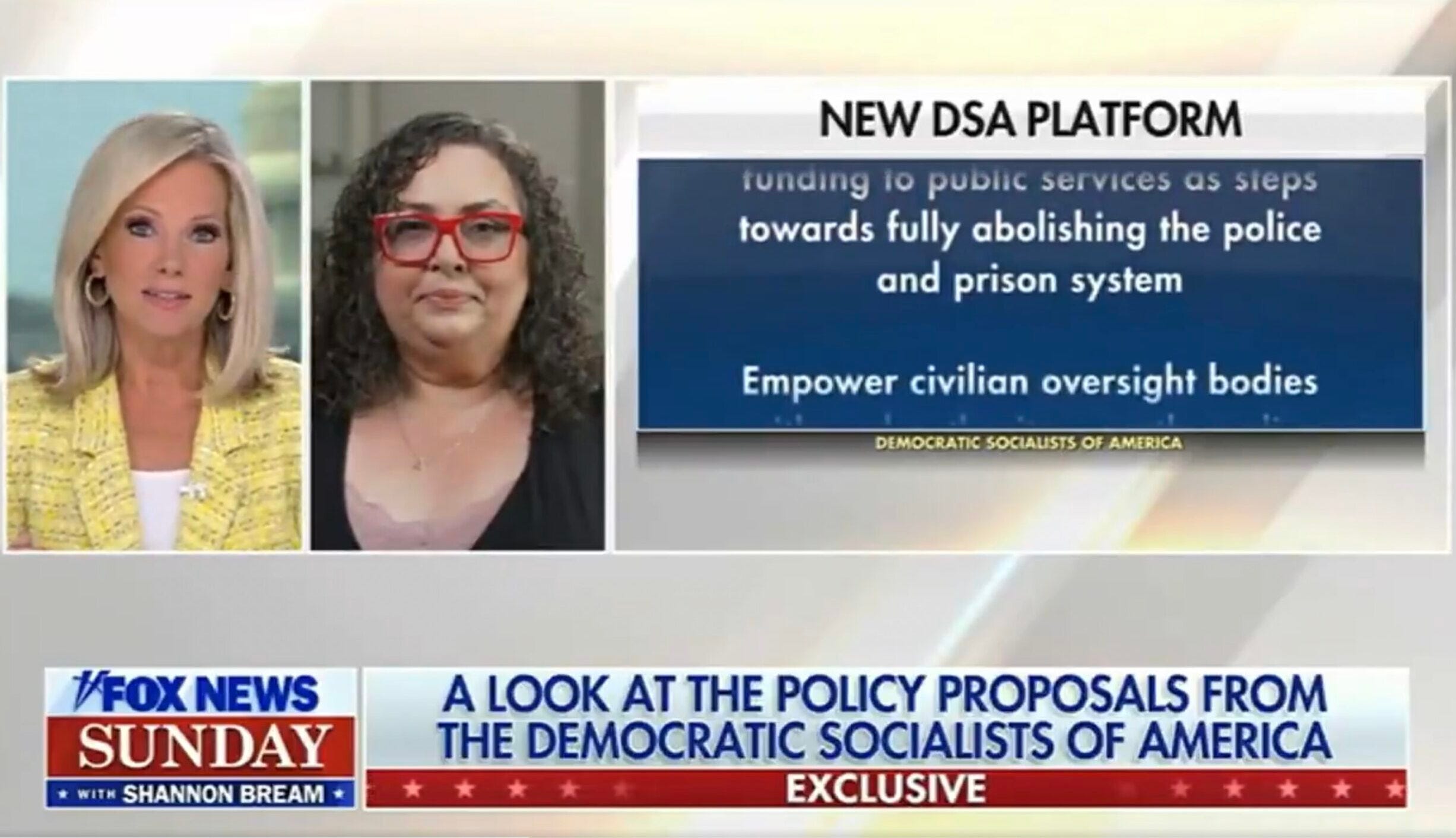
Lehrer: Megan Romer, DSA National Co-Chair, with Fox’s Shannon Bream. Certainly you haven’t heard words like most of those from Mamdani or Ocasio-Cortez, for example.
So let’s explore the dialogue taking place within the DSA right now with Eric Blanc, assistant professor of labor studies at Rutgers. He writes the Substack newsletter Labor Politics and is a member of DSA’s Bread and Roses caucus. Eric, always good to have you on with us. Welcome back to WNYC.
Eric Blanc: Thanks so much for having me on. And as a disclaimer, I should say that I’m not speaking in the name of Bread and Roses here, but in an individual capacity.
Lehrer: Fair enough. Can we establish first where you are within the organization? I see you’re a member of the Bread and Roses caucus — you acknowledge that. Would you describe what that is, and its role in DSA as you see it?
Blanc: Sure. I think the most useful way to frame the divisions in DSA is that there’s, broadly speaking, a right wing and a left wing — and this is within the context of DSA, so these are very relative terms. Overall, I would consider myself mostly sympathetic to the right wing. Bread and Roses is a center current, but I’m on the right wing of Bread and Roses — so this gives you a sense of how complicated it is.
Broadly speaking, people on DSA’s right would self-identify more with mass politics — trying to reach out as broadly as possible, in a way that makes us more legible and attractive to bigger numbers of people. And on DSA’s left, they see themselves as more consistently revolutionary and less prone to co-optation. The big divide is between that left and right, and the internal nuances are a little bit secondary to that.
Lehrer: For all your appearances on this show, one thing I never thought I’d hear was you referring to yourself as right wing, but I understand the context. So what did you think of that Megan Romer clip? How much does it represent you? Or should people take it as representing where DSA candidates in the midterms, as a group, want to take the country?
Blanc: I’d put it this way: DSA has this amazing opportunity at this moment to give a voice to and organize literally hundreds of thousands of people, potentially millions. That’s the kind of scale that socialist parties in the rest of the world — or in the U.S. in the past — have aspired to and oftentimes achieved. And my criticism of that Megan Romer clip, and some of the similar things that have been said from the left wing of DSA, is that I think it’s falling into a trap being set by the establishment — both conservatives and liberals — which is to try to paint DSA as extreme.
We can go into the specifics of which of those points she made I agree with or not — I’m happy to talk about the particulars. But the basic point is that when we go on national news, whether it’s Fox or the New Yorker or whatever, that’s an opportunity to stress to millions: democratic socialists are the only political current that has a solution to the crises that ordinary working people are facing — the affordability crisis, the crisis of political democracy, all of these things that are felt immediately. When we get into the terrain of distant debates about what could happen way down the road, that’s the terrain the Democratic establishment wants us fighting on. That’s the terrain the Republican establishment wants us fighting on.
What we need to do, if we’re going on Fox, is to pivot very consistently to saying: look at what Zohran has done, we’re making people’s lives better, we’re fighting for the interests of working-class people. It’s very pragmatic — we’re winning free expanded childcare, we’re winning a rent freeze. If you can’t pivot to the ways we’re going to make a difference in people’s lives, then you’re only going to appeal to the radical activists. And right now we have an opportunity to speak much more widely — we’re seeing that in the votes we’re getting for our candidates. But I don’t think we’re seeing that articulated as consistently as possible by some of our national DSA leaders.
Lehrer: It sounds like you’re saying Megan Romer blew it on Fox.
Blanc: I certainly would not have argued in the way that she did. I don’t think that’s an approach that’s going to be able to build the type of power we need to win the types of changes that the American people and working-class people deserve.
Lehrer: Here’s an example, I think, of the position that statements like that put some of the actual candidates for office in. This is an exchange I had with Democratic Congressman Tom Suozzi, who represents a swing district in Queens and Long Island. He’s been making a point of calling himself a “democratic capitalist,” and he made his point in an exchange with me, partly like this.
Tom Suozzi (in clip): It’s important to look at what the democratic socialists include in their platform. When they tell you what they believe in, we should believe them.
Lehrer (in clip): But that’s the premise of my question. There’s a national DSA that has these policies on paper — the platform specifics. Then there’s Zohran Mamdani, Bernie Sanders, others in real-life politics, who I think it’s fair to say are not advocating the most extreme things you were just citing.
Suozzi (in clip): I don’t think it’s fair to say that, because they need to be asked those questions. How do they feel about, for example, the Chinese Communist Party? I’m the founder and co-chair of the Uyghur Caucus — the Uyghurs are Muslim minorities held in forced labor camps in China. Why don’t we ask Mayor Mamdani: does he support what the Chinese are doing with the Muslim minority in China? Does he support the idea of abolishing the Senate, or abolishing the presidency, or defunding the police, or getting rid of the Department of Defense?
Lehrer (in clip): He’s in office, governing now for six months, and I don’t think I’ve heard him talk about any of those things.
Suozzi (in clip): Well, why don’t you ask him specifically the next time you have him on your show? Does he want to get rid of prisons altogether? That’s part of the platform. I’ve been in politics for a long time. I’ve been on your show many times. I’m held accountable for the things that I stand for. I’m held accountable for the platform of the party that I represent.
Lehrer (in clip): Well, does it say something to you that he just declined to defund the police? In fact, he ran on keeping NYPD headcount steady.
Lehrer: That went on for a while more with Congressman Suozzi and me last month. But you see his argument, Eric, right? That every DSA candidate has to have a position on those positions, because they’re on paper in the platform. And that was before Megan Romer went on Fox — so now we have that too. So: are purity tests taking place within the organization, or just abstract debates about how socialist is socialist enough in 2026 America?
Blanc: The first thing I would say is that in the chapters of DSA that are electing people across the country — or electing mayors, as with New York City DSA — there’s actually not so much division. So some of these attacks are really quite bad faith, because there’s not a lot of light between the politics of Zohran Mamdani and New York City DSA and its leadership.
These internal DSA divisions we’re talking about, in many ways, are between the caucuses and chapters that I would consider to have proven themselves able to do mass politics — by electing large numbers of people, but also by growing in large numbers — and caucuses and chapters in other parts of the country that as far as I’ve seen haven’t yet been achieving that same degree of success, which reflects and contributes to some doctrinaire positions. So I don’t think there’s so much division between DSA’s elected politicians and the chapters who helped elect them. It’s an understatement to say that DSA is not a very centralized organization. It’s a very decentralized organization.
I would say, though, that the concern you flag is a very real one. I think it’s frankly just a mistake that national DSA took certain positions that are both marginalizing for us in the short term and just politically wrong even in the long term. To give a concrete example: I don’t think it’s strategic to say that we’re for abolishing the police or prisons, even in the long term. Even in the distant socialist future, you can imagine there’ll be some sort of apparatus for that. And particularly at this moment — when taking a position on that is going to provide so much fuel to all of those trying to discredit our elected officials and our candidates and our organization — why take such a stance? In what world does it make sense, if our goal is to organize millions of people and to overcome the Democratic establishment and to defeat Trumpism, to take a position that you know is just going to give fuel to your opponents, and for which there’s no practical upshot right now? Taking that sort of doctrinaire ideological position seems to me a reflection of a lack of experience and a lack of engagement in mass politics.
If you’re a person relatively new to socialism — oftentimes you were a liberal not very long ago, and you got radicalized because Obama didn’t do what he said he was going to do, Hillary Clinton lost, or Schumer refuses to fight — so you flip your position. And you then kind of go too far in the other extreme. I had lots of those positions and limitations when I was new to socialist politics too. There’s a learning curve — you have to learn mass politics through experience; it’s not the type of thing that you can pick up just from reading or even just through small-scale activism.
So basically, Brian, you’re right. But my nuance with your concern is that those aren’t positions being taken, for the most part, by the actual chapters that are electing these candidates and that are recruiting the largest numbers. There’s a far-left wing of DSA that has pushed to adopt those stances on a national level, oftentimes against the will of the chapters that are actually electing these candidates. So I think it’s disingenuous, frankly, for the opponents of DSA to try to pick and choose this or that controversial position when it’s not actually the reality of what our candidates and our most powerful chapters are saying or doing.
But I do want to also give a defense of DSA as a whole, including of people on the left of DSA with whom I have serious disagreements. There are very few spaces in national or local politics today where people can debate and engage in democratic decision making. Where else can you join an organization that can have real and substantive differences like this? That’s to DSA’s credit. If you think DSA has limitations — we all do — then you can get involved and help make it better.
Lehrer: Sally in Manhattan, you’re on WNYC with Eric Blanc.
Sally (caller): I think it’s naive to say that there are two sides to the democratic socialist group. I have always been a Bernie Sanders supporter. AOC, they go for FDR, they go for Scandinavian socialism, which includes capitalism and socialism together. Whole different group. Megan Romer is an avowed Marxist — which is why Trump is now saying that communists are on the left side. She wants production to be in the hands of the people. She wants to get rid of capitalism. I think she’s actually trying to split the social democrats — that’s her purpose, to minimize the movement. And I think we have to not be naive about this, and call her out — her and the group that is doing this — as opposed to the Bernie Sanders, AOC kind of social democrat. This is a very serious thing. And thank God you’re bringing up this issue, because they’re not all the same people, and it’s not all one movement right now. She is seriously trying to split the movement.
Lehrer: Sally, thank you very much. Eric, do you agree with her analysis that Megan Romer is intentionally trying to split the movement?
Blanc: No, I don’t think it’s intentional. I think that in practice some of the DSA left’s approaches do undermine the movement, and it does in practice lead to all sorts of excessive divisions. One of the things I’ve found particularly counterproductive is that the left of DSA has spent a disproportionate amount of time criticizing our candidates and our elected officials. So I do think there’s some level of factionalism in that.
But the way they look at it is: people are disenchanted with politics as usual. The reason they think people are coming to DSA — and there’s a lot of truth to this — is that we stand for something different than what’s been on offer for decades, and that we don’t make the same compromises the Democratic establishment constantly does. And so the left of DSA is concerned that if we start going down that slippery slope of compromise, then we’re just going to demoralize our base and become like any other Democrat.
Now, I think the conclusions they draw from that analysis are wrong — they go too far. But there’s a kernel of truth to it. So you don’t have to assume people are acting in bad faith, or trying to split, to say that in practice their politics and the way they’re going about it is making it harder to grow democratic socialism — which to my mind means fighting centrally, in the short term and mid-range, for social democracy. We’re never going to get to economic democracy or socialism without first winning something like Scandinavia.
Lehrer: The caller cited that term, social democrats, and I want to play a clip of DSA candidate Darializa Avila Chevalier from an appearance on this show. This is after she won her primary, and I asked her what country, if any, she sees as a model of democratic socialism that the U.S. could emulate if DSA gains enough influence. Here’s 30 seconds of her answer.
Avila Chevalier (in clip): There’s a lot we can learn from many parts of the world — I think places in Europe, like Sweden and Norway, for example. But I think looking specifically at the programs themselves — what are the models of the programs, and how can we implement them here — is how I envision this. And I think the other thing that gets lost is the democratic part of this phrase, democratic socialism: that we are making decisions in a democratic way about how we use the wealth that we have produced in this society, because the people who are producing the wealth are the people who produce the labor — the workers.
Lehrer: Are you surprised she cited the Scandinavian model? We know that in her old tweets — which she has mostly disavowed now, she says she’s grown — she sounded more like Megan Romer on some points. But my understanding is DSA says there’s a difference between social democracy — you and the caller and Ms. Avila Chevalier all used that term — and democratic socialism. That democratic socialism goes further than European-style social democracy. Can you explain how true that is, and how much you think it should matter in the current context?
Blanc: I don’t think in our current context it matters so much what labels you use. But for what it’s worth, the parties that won the most robust welfare states (what many people refer to as social democracy): Sweden, Norway, a lot of Western Europe — they were, for the most part, socialists. They were what we’d call democratic socialists today, in that their horizon was not limited to just making capitalism less bad. They did make capitalism less bad, and they did that very effectively. But in part they were able to do that so effectively because they had a compelling vision of spreading democracy to all spheres of life.
So I do think that is a difference between democratic socialism and somebody who just believes that the most human beings can aspire to, for as long as human civilization exists, is some sort of capitalism. If you believe in democracy, I don’t think there’s any reason to preclude the possibility of democracy expanding to the economic sphere — even unions are steps in that direction.
The way to look at it is: yes, in the immediate and mid-range, we’re fighting for something like Sweden in the 1970s — a very robust universal welfare state. That would be so much better than what we have. It would alleviate so much suffering. And part of the problem I have with the way Megan Romer articulated it, particularly in the New Yorker interview, was to counterpose these two things, saying “we’re not fighting for a kinder, gentler capitalism.” But, actually, you don’t have to counterpose that to socialism. You’re never going to get to economic democracy if you can’t first win a robust welfare state, if you can’t rebuild a mass workers’ movement, in other words, if you can’t make capitalism kinder and gentler.
And this is the crucial point: the reason so many people think transformative change is impossible today — including just social democracy — is that they’ve lost hope. They don’t think things can get better, they don’t think government can work for them, and they’ve lost confidence that things improve through collective action or the public sector.
So we have to fight hard even for things like Medicare for All, even though this is something most of the rest of the industrialized world already has. Until we can start showing people in practice that the government can work better — that’s why what Zohran is doing is so important — and until we can give them confidence in their own strength, and in the strength of solidarity and working-class struggle, you’re never going to be able to get to the long-term socialist future. So anything socialists do that counterposes the long-term goal to the immediate fights is very detrimental to the cause, both short-term and long-term.
Lehrer: One more call. Judith in Saugerties, you’re on WNYC.
Judith (caller): Why doesn’t DSA ever explain its positions? For example, “defund the police” — which is a really bad statement. But it really was not defunding the police; it was taking part of the money that’s going to police departments and moving it to other services, like mental health. That’s what I understood it to be. But I haven’t heard a single person say that — and especially not Megan Romer. By the way, I agree with you, she is not a good spokesperson. Or “end the Senate” — I mean, the Senate is probably the least democratic, small-d, governing body in the Western world.
Lehrer: We could definitely do a whole segment, of all the things on that list, on the Senate as a violation of the one-person-one-vote principle — when people in Wyoming, with a few hundred thousand people, get the same number of senators as people in California, with 40 million. But on defunding the police, Eric — there are differences of opinion within DSA on this too, right? Some people do talk about police abolition, they use that word, whereas others, like Judith is saying, mean by “defund the police” something more like reweighting where public money goes.
Blanc: I think the slogan “defund the police” is very confusing, and it’s good that DSA candidates and most DSA chapters aren’t using it — because it makes it sound like you don’t think any money should go toward the police in the short term. But I think it’s entirely the case that we should be funding social services and public services much more than we’re funding incarceration and repression. That’s a message we have to make, and we are making it. And I think it’s possible to do that without using a slogan that gives our opponents an ability to marginalize us.
Lehrer: Eric Blanc from Rutgers and The Nation, and sometimes Jacobin, and his book We Are the Union. Thank you so much for having this conversation with us.
Blanc: Thanks so much for having me on.
More
NYC friends, you should attend the launch for a great new book, Against Tech Oligarchy, by JS Tan & Clarissa Redwine. The event is 6:30pm tonight (Monday August 17) at 207 32nd Street, RSVP here.
Please share this interview with folks inside and outside of DSA. And if you haven’t yet, please join DSA! We’re over 125,000 members now, and need everybody’s help to seize this moment.
I think we all need to emphasize DSA's democratic processes in interviews, and our desire for increased democracy everywhere. DSA wants to expand democracy in the political sphere (our distant constitutional changes are part of that) and to the economic sphere. So while we are calling for an expanded house, with proportional representation, it's so we can have a multi-party democracy instead of what we have now. But obviously changing the constitution is a massive lift, to put it lightly.
Also, if you want to criticize Megan, I would suggest you do it in the forums, where she can respond, rather than on a popular NYC radio show.
I do wish we had divided the program into long-term goals and short term goals, but oh well. It would make it easier for candidates to pick out the ideas they want to emphasize.
Not a great analysis of the DSA movement beyond the walls of the ivory tower. Eric misses — pretty blatantly — the urgent need for DSA to actually be organizing against the carceral state and mass policing.
The DC chapter — the DSA's third largest — elected a socialist mayor, a councilmember and produced a broad left sweep of the local government just two months back. It is also one of the few chapters that has an organized and active "Abolish Police" working group — so large it often attracts members from other chapters who seek to build their own. The deep base-building and community outreach engaged by organizers who led with these ideas is what produced the conditions for a monumental shift in the city.
You actually do need to have an analysis for what you are going to do about the overburdening of public budgets (and common morality) with rogue and consistently expansive police states. It's really not enough to just say "we're not going to defund" and point fingers at the spooky "left" wing of the organization. If you are not thinking through these problems seriously, working-class voters — who have to actually deal with the problems produced by failed police models in this country — will never find you credible.