
By Eric Blanc, Claire Sandberg, and Wes McEnany
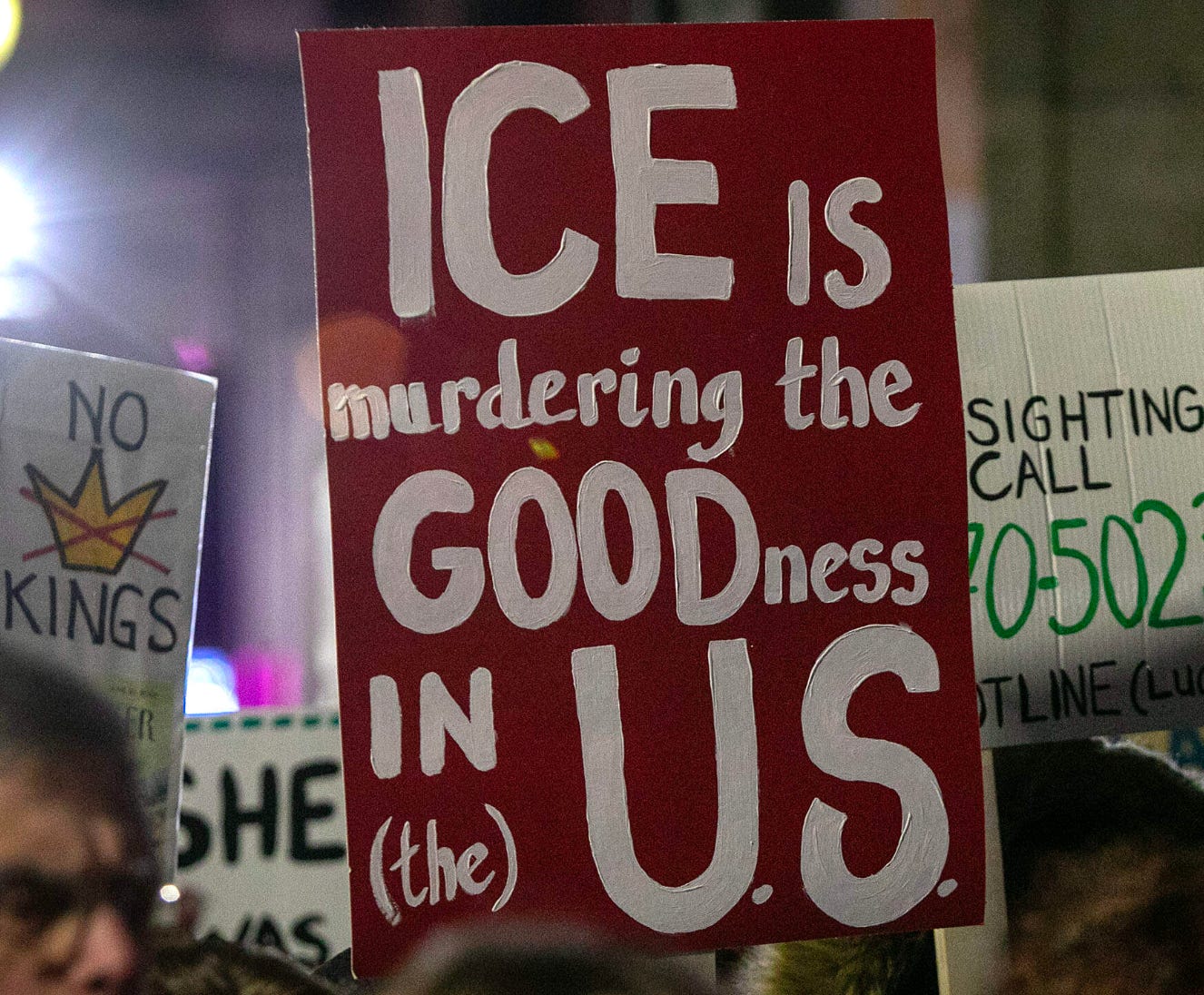
Renee Nicole Good’s murder by an ICE agent in Minneapolis has left millions of Americans wondering how we can stop ICE from terrorizing our communities any further. There are many well-known ICE-fighting tactics that we can and should use, like protests, know-your-rights trainings, and neighborhood watches. But two recent victories show a promising, relatively underutilized path forward—one that deserves to be pursued further: we can target businesses to break from ICE.
ICE relies heavily on the private sector to help carry out its Gestapo-like crusade against immigrants and their allies. Without the logistical, financial, and political support of business, its capacity to terrorize our communities would crumble.
Over the past week, activists around the country successfully pushed Avelo Airlines to stop running deportation charter flights, and workers in Minneapolis pushed a local Hilton affiliate to stop renting rooms to ICE agents. But these wins are just a fraction of what could be achieved if the millions of people who are outraged by ICE’s thuggery organize to pressure all companies to stop working with ICE.
Trump’s Pillars of Support
Anti-authoritarian scholars and organizers stress that the most important thing for pro-democracy movements to do is to peel away a regime’s “pillars of support.” Even the most despotic of regimes can’t rule without the backing or consent of powerful external institutions. Businesses are society’s most important non-state institutions, and most of the biggest ones in America are collaborating with Trump, making themselves a very steady pillar of support for his rule.
These mega-corporations have immense financial and political power. It may seem like there’s nothing to be done to bring them to heel. But the successes with Avelo Airlines and the Minneapolis Hilton—as well as earlier pressure campaigns like the #Tesla Takedown, the fight to force Disney to rehire Jimmy Kimmel, and the boycott of Target over its Trump-friendly anti-DEI moves—show the immense leverage that consumers and workers have when provided an opportunity. We are not powerless, and there are concrete actions anyone can take to start eroding Trump’s support from big business.
Consumer pressure campaigns can start with petition gathering and social media callouts, then escalate to coordinated one-day boycotts. Workers have even more leverage: employees can circulate internal petitions calling on their CEOs to cut ties with ICE and organize collective actions like sick-outs.
Tactics can include rallies in front of targeted stores, flyering customers about a company’s ICE contracts or collaboration, and nonviolent civil disobedience that makes clear that business as usual won’t stand. Other creative ideas include setting up anonymous tip lines for employees to whistleblow on non-public ICE collaborations, pressuring job sites like Monster.com and Indeed to stop featuring ICE job listings, asking local small businesses to post “Immigrants Welcome Here” placards, and writing online reviews calling out companies’ collaboration with ICE.
The key is providing people with concrete, outwards-facing activities they can take right now, while building an escalating national campaign that can culminate in larger coordinated days of nonviolent disruption—for example, on May 1, 2026.
National online mass calls and trainings can give large numbers of people the tools they need to get started. National unions, immigrant rights groups, and organizations like Indivisible and the Democratic Socialists of America can leverage their volunteer activists and resources to help launch and support the campaign. And high-profile politicians like Bernie Sanders, Elizabeth Warren, Alexandria Ocasio-Cortez, Chris Murphy, and Zohran Mamdani can use their platforms to build momentum around this urgent fight.
Corporate Targets
The most strategic corporate targets fall into three categories: low-lift national targets, high-lift national targets, and local targets.
Low-lift national targets are mostly public-facing companies with relatively small ICE contracts that are set to expire soon, making them particularly vulnerable to consumer and employee pressure. Campaigns against companies like these can play a crucial role in generating further momentum against ICE, Trump, and their worst corporate collaborators.
Here are some examples:
Dell ($18.8 million contract with ICE for Microsoft software licenses, expiring March 2026)
UPS ($90,500 small package delivery contract with ICE, expiring March 2026)
FedEx ($1 million delivery services contract with ICE, expiring March 2026)
Motorola Solutions ($15.6 million tactical communication infrastructure contract with ICE, expiring May 2026)
Comcast ($24,600 internet services contract for ICE Seattle office, expiring May 2026 — this could be a great fight for new mayor Katie Wilson to take on).
AT&T ($83 million IT and network contract with ICE, with a potential end date of July 2032).
LexisNexis ($21 million data-brokerage contract with ICE — this company is particularly vulnerable to pressure from university students and professor unions, since much of its revenue comes from colleges.)
Home Depot and Lowe’s are using AI-powered license plate readers and feeding this data into law enforcement surveillance systems accessible to ICE. Their parking lots are also regular sites of ICE raids targeting day laborers.
High-lift national targets have deeper relationships with ICE, and will be harder to pressure. But two in particular need to be tackled.
Amazon provides ICE with the digital backbone for its data and surveillance operations through Amazon Web Services. Amazon’s Whole Foods stores are a rich potential target for nonviolent disruption on big days of action.
Palantir provides ICE with core data platforms that integrate and analyze information from many databases so agents can search, link, and manage deportation operations.
It will take longer to force these behemoths—the two worst corporate collaborators with ICE—to cut their ties, but it’s essential to publicize their centrality to Trump’s deportation machine.
Local targets can be found in communities across the country, where hundreds of smaller business have ICE contracts. Local activists can research and target these businesses—from contractors providing services to ICE offices to suppliers selling equipment—creating distributed pressure campaigns in every region where ICE operates. Hotels that rent rooms to ICE agents are particularly vulnerable targets, as the Minneapolis example demonstrated, and hospitality unions can play a key role in these campaigns.
Defend Immigrants, Defeat Trumpism
Breaking companies from ICE is a winnable struggle that can put serious pressure on the administration by raising the political cost of mass deportations and damaging ICE’s ability to function. No administration can survive long without the consent of corporate America.
Obviously, the stakes are highest for our undocumented friends and family members. But this fight impacts all of us. To stop Trump’s authoritarian oligarchy, we need millions of people — well beyond our normal circles of activists — to join the fight.
Who is going to stop Trump from invading more countries and stealing the 2026 and 2028 elections if not a mass movement from below? Who is going to force politicians, whether Republicans or Democrats, to stand up for immigrant communities? Who is going to make corporations pay a price for collaborating with the Trump regime? We need to start building the organizing muscle and connective tissue now for widespread nonviolent disruption. Strategic organizing to win justice for all is the best way to honor the memory of Renee Nicole Good and the countless other victims of Trump’s inhumanity at home and abroad.
More
We won a huge victory this week: NY Governor Hochul yesterday announced with Mayor Mamdani that she’s backing an ambitious extension of childcare across NYC and the state. But her funding is only promised for two years — which is why we need to ramp up our organizing to tax the rich, to make these big childcare victories permanent. Sign up here for an upcoming canvass.
Are you a high school student in NYC — or know one? High school organizers are circulating this pledge to walk out when Trump surges ICE.
Union organizer and democratic socialist Claire Valdez is running for Congress in New York’s 7th district. Claire is a fantastic comrade and she’s going to be DSA’s first cadre congressperson, please sign up to canvass and donate here!
Union organizer Analilia Mejia is running for Congress in New Jersey’s 11th District. You should sign up to donate and canvass. (I got to know Analilia, Bernie’s 2020 Political Director, when I helped organize hotel and casino workers on the Las Vegas strip to vote for Bernie; I remember on the day of the primary weeping from joy with Analilia in the Bellagio ballroom the moment it was clear Bernie’s supporters outnumbered Biden’s backers. Seems like a lifetime ago —and hadn’t felt that type of political euphoria again until Zohran’s victory.)
Please share this article widely on social media and beyond! A national campaign against ICE’s corporate collaborators needs all your help to get off the ground, everything you can do to share this piece is super appreciated.
Thank you for this information, I just heard you on the Brian Lehrer show- very informative!
One of the few issues where Trump still carries majority support is on the closure of our borders and the deportation of unauthorized immigrants. Virtually every other campaign promise to working people has been completely repudiated.
The paranoid fantasy that he can steal the election in 2026 or 2028 is directed connected to the fevered dream that Jan 6 was an effort to overturn the 2020 election. If you are serious about building a real movement to make sure that 2026 (or 2028) aren't simply another volley in the ping pong game between Democrat and Republican corporate mouthpieces, you need to focus on the issues that concern Americans outside NYC.