

What will it take to stop ICE and Donald Trump? More and more Americans are coming around to the following answer: a general strike.
They’re right to move in that direction. General strikes are a powerful tactic that have defeated corrupt and authoritarian rulers across the world, most recently in Egypt and Tunisia in 2011, Puerto Rico in 2019, and Sri Lanka in 2022. As the union anthem “Solidarity Forever” puts it, “without our brain and muscle not a single wheel can turn.”
Unfortunately, last Friday’s national call for “no work, no school, no shopping,” billed widely as an anti-ICE general strike over social media, came nowhere close to the projections of its most vocal advocates. Economic disruption was minimal, though workers from Grey’s Anatomy did force production to shut down for the day.
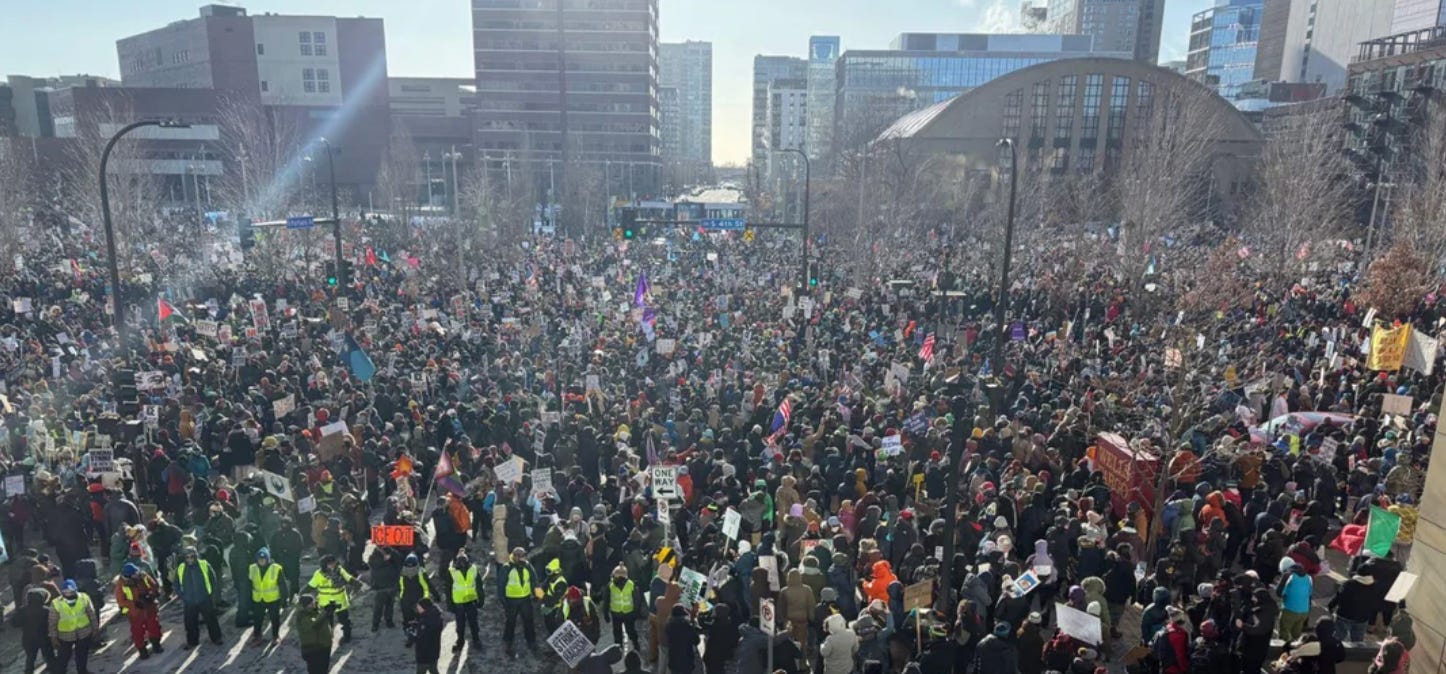
In contrast, Minnesota’s Day of Truth and Freedom one week earlier on January 23 did give a glimpse of the power of everyday people to make the system tremble. Many (though not most) businesses were shuttered. And over 75,000 people poured into downtown Minneapolis in the middle of the workday, braving -20°F chills. As SEIU Local 26 president Greg Nammacher put it on the Dig’s excellent new episode on Minneapolis,
We achieved things [on January 23] that were not imaginable two weeks before. … It really did feel like history to our members. I know many Uber and Lyft drivers just started crying when we were checking in with them that day about seeing [roughly one hundred] pastors getting arrested at the airport, seeing all those people pouring downtown to defend them.
How did Minneapolis achieve such a widespread work stoppage on January 23? What do the limitations of that day and the January 30 actions suggest about the path ahead? And what can the history of general strikes tell us about how to make the system’s wheels finally stop turning in the US?
Real General Strikes
Before we can answer those questions, let me briefly clarify what I mean by “general strike,” a term whose meaning has gotten twisted by overuse in recent years.
Academics and activists can endlessly quibble over definitions, but a general strike is basically a work stoppage that paralyzes multiple major industries. Such actions can be primarily political — demanding changes from the government — or economic, demanding changes from employers.
In that light, it’s not hard to assess whether recent anti-ICE actions in Minnesota and nationwide were real general strikes. On January 30, high school students walked out across the country, there were various sizable marches across the US, numerous small businesses closed for the day in solidarity, and a significant but unmeasurable number of people probably called in sick or didn’t shop. That’s great. But definitely not a general strike.
January 23 in the Twin Cities saw much more widespread workplace disruption. Schools were closed (though this was partly due to the extreme cold). Multiple cultural institutions like museums were shuttered. Organizers estimate that roughly 1,000 businesses, overwhelmingly small proprietors, participated and that roughly a million Minnesotans supported the action in some form that day.
This was a monumental achievement, further evidence of the state’s grassroots heroism and the strategic savvy of its progressive unions and community organizations. As Minneapolis Sunrise Movement organizer Aru Shiney-Ajay explained to me in an interview last week, January 23 “was a fantastic start.” But she’s also right that “we have a lot further to go to actually flex our muscles by shutting down the economy” and that “it’s going to take a lot more work” to build “real general strikes.”
This isn’t an abstract debate over semantics. There is a “boy who cries wolf” danger if too many calls for general strikes don’t materialize: when the possibility for one actually becomes real, too many Americans may tune out the message. (In fairness, the community organizations that initiated January 23 and the student groups that initiated January 30 did not project these as “general strikes.” That framing was subsequently pushed by influencers, celebrities, and left activists online.)
And it’s crucial to acknowledge the major limitation of both January 23 and January 30: neither seriously disrupted the major corporations that prop up ICE and the Trump administration. This is a sobering fact, especially since popular organization, ambitious union-community leadership, and grassroots momentum is stronger in Minneapolis than anywhere else in America. Minneapolis’ movement surged ahead after Renée Good’s murder — nevertheless, it still came up short of the type of disruptive economic power that can scare corporate America into breaking from ICE and the Trump regime.
But popular opinion is changing very quickly in our country. Trump and ICE’s brutal, unpopular actions are not likely to stop anytime soon. Organizing initiatives that might seem impossible today can suddenly become feasible in whirlwind moments of mass outrage and effervescence. Making the most of those openings will depend above all on what we do in the meantime. If we take a lead from Minnesota and pivot nationwide to involve millions of people via winnable fight-backs against ICE, a real general strike can become a reality in the US.
Momentum
Organizing a general strike requires some combination of three ingredients: momentum, organization, and militant, risk-tolerant leaders. The proportions can vary — if you have more momentum, you can succeed with less organization and so on. But until we have a sufficient combination of these factors, a general strike will remain a wish rather than a reality.
It takes much more than a viral social media post to shut down the economy. This doesn’t mean celebrities, influencers, and social media agitation don’t have a role to play: in the 2019 general strike that eventually brought down Puerto Rico’s embattled head of state, Bad Bunny, Residente, and Ricky Martin spread the action far beyond longtime activists. And radio DJs were central to generating awareness and energy for 2006’s “day without an immigrant” mass protests in the United States.
But conditions have to be ripe for a general strike to catch on. Of these external factors, the most important is momentum: a struggle’s propulsive forward motion, which leads large numbers of people to pay attention and consider joining.
The need for strong momentum cuts against the suggestion of some seasoned US labor organizers that you can bring about a general strike simply by scaling up traditional strike preparation tactics like having one-on-one conversations with all your co-workers and launching escalating super-majority “structure tests” to measure support. Almost every general strike in US history has been sparked by a much smaller labor struggle whose dynamism, popularity, and confrontations with authorities generate enough momentum for large numbers of other workers to suddenly jump in to show solidarity (see table below).
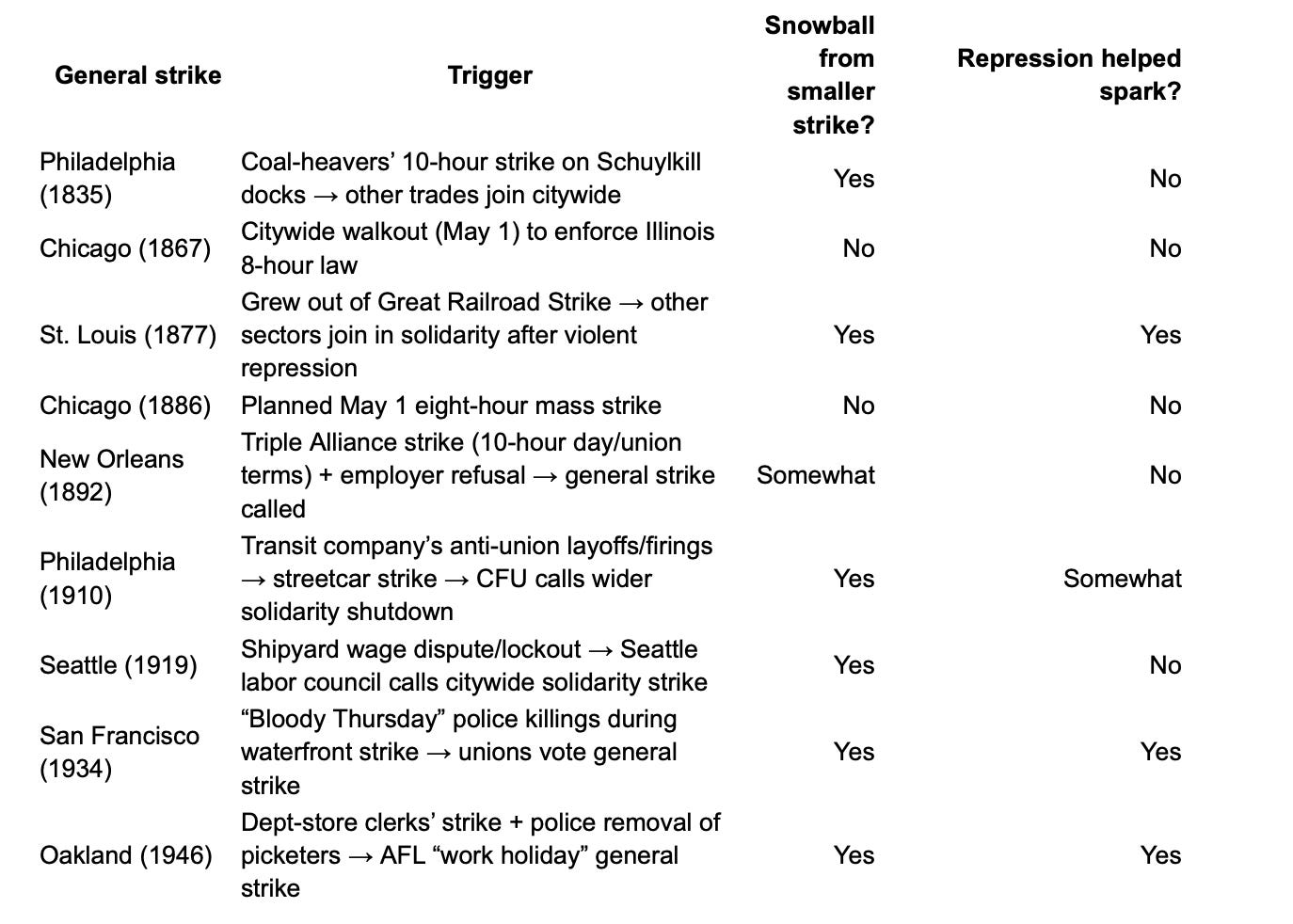
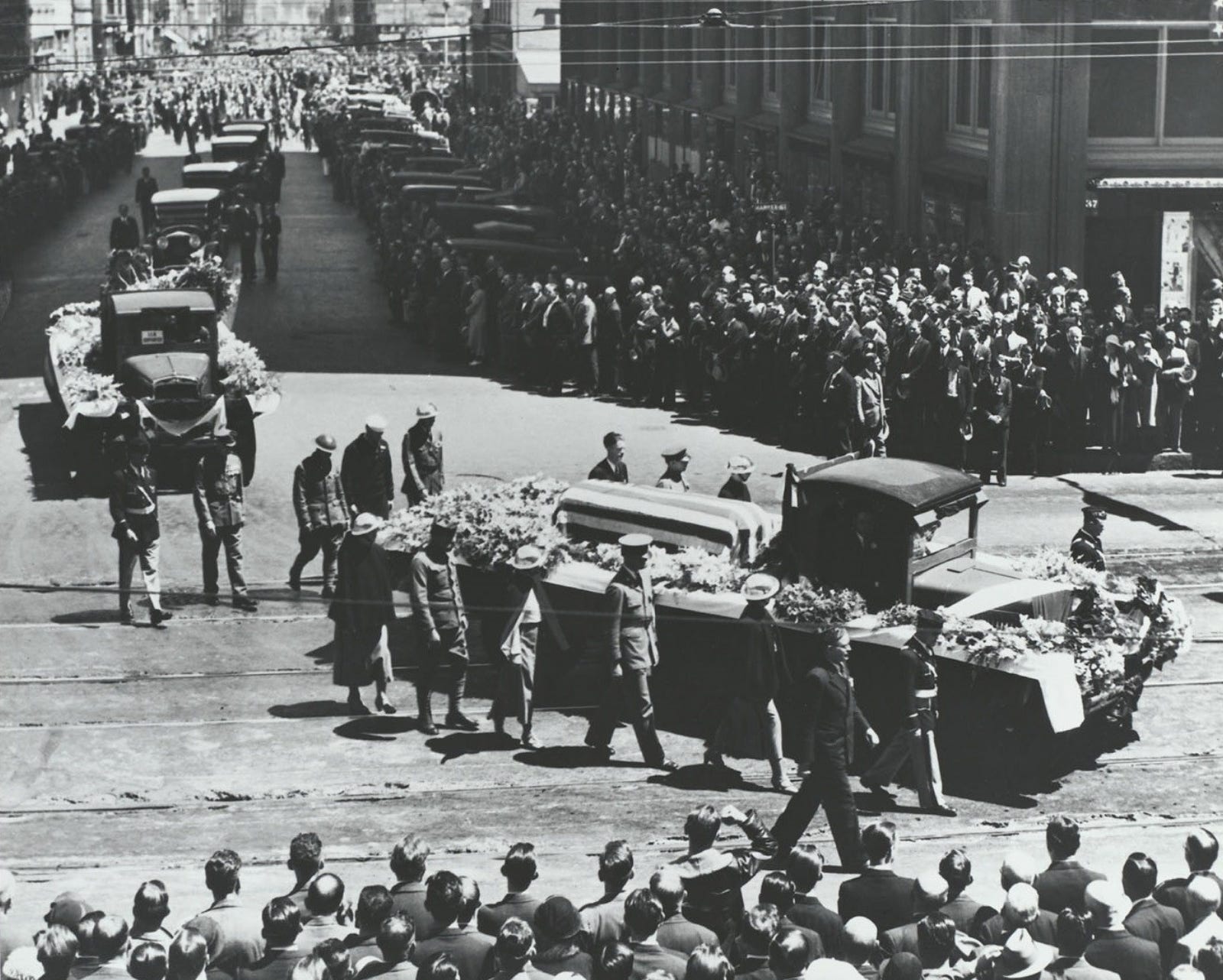
The 1934 San Francisco general strike, for instance, erupted as a response to the “Bloody Thursday” police murder of a striking longshore worker, Howard Sperry, and a volunteer from the cook’s union, Nick Bordoise. Bay Area politics was upended overnight. Tens of thousands of workers poured into the streets of downtown San Francisco that Sunday for the funeral march:
Faces were hard and serious. Hats were held proudly across chests. Slow-pouring like thick liquid, the great mass flowed out onto Market Street. … Not one smile in the endless blocks of marching men. Crowds on the sidewalk, for the most part, stood with heads erect and hats removed. Others watched the procession with fear and alarm. Here and there well-dressed businessmen from Montgomery Street stood amazed and impressed, but with their hats still on their heads. Sharp voices shot out of the line of march: “Take off your hat!” The tone of voice was extraordinary. The reaction was immediate. With quick, nervous gestures, the businessmen obeyed.
The employer’s association subsequent account of the strike noted that this funeral procession “was one of the strangest and most dramatic spectacles that has ever moved along Market Street,” and that by the end the march, “the certainty of a general strike, which up to this time had appeared to many to be a visionary dream of a small group of the most radical workers, became for the first time a practical and realizable objective.”
We saw a similar dynamic in Minnesota in response to ICE’s surge and especially after Good and Pretti’s murders. Mass consciousness advanced quicker in a few weeks than over two decades of ambitious, deep organizing for change.
Greg Nammacher from SEIU Local 26, which represents over 8,000 janitors and other property service workers, notes that their victorious struggles in years prior for progressive policy changes — including the 2023 “Minnesota Miracle” — “did not trigger the imagination of the broader community … it was not this level of being on top of a wave.” In contrast, most strikers in the January 23 Day of Truth and Freedom were not union members.
Here’s how he describes the impact of the Twin Cities’ recent momentum surge on the Dig:
There are so many players in motion right now—organized on their blocks, organized through signals. Groups and structures that didn’t exist, or didn’t exist at an organizational level, just weeks ago are now playing key roles. So from my perspective, this is an incredibly hopeful story about combining systematic, intentional, self-conscious organizing with … understanding that in a movement moment when the entire community is provoked, things will move far beyond your organizational control.
This community outpouring, Nammacher notes, has required adopting a different approach to building disruptive actions:
Usually, when a union gets ready to strike — or when we’re trying to do turnout to an action — every single person we’re engaging has been carefully, relationally propositioned to step into action, supported in a very intentional, systematic way. And in this moment, there’s a surge of momentum that is just breathtaking and comes from every direction. It’s that heroism — and the risks that people, even outside of organization, are willing to take — that has combined to make this so powerful.
Minnesota shows that you can’t organize an ambitious mass strike like January 23, 2026 or May Day 2006 — let alone a real general strike — until the iron is hot enough. That’s one of the main reasons why all the recent online-based calls for nationwide general strikes have fallen flat. As angry as so many people are at ICE, fears about getting fired as well as day-to-day affordability concerns are still front and center for most working people, especially those without college education.
This dynamic also puts a question mark over the US Left’s over-focus on May Day 2028 as a projected general strike. While it’s great that the United Auto Workers’ initial call for this action has raised the discussion of general strikes, it was originally imagined as an action built by unions lining up their collective bargaining contracts with employers (something that does require years of preparation) — not as the North Star disruptive mass action aiming to save US democracy from Trumpism and the billionaires. There’s a danger that in the name of building towards May Day 2028, union and movement leaders could fail to seize the openings for disruptive action that may rapidly emerge over the coming weeks and months.
Moments have to be seized, as Minnesota’s January 23 action positively demonstrated. If Trump attempts to invoke the Insurrection Act or overturn midterm election results, we’ll need to act quickly.
Some have pointed to the 1886 May Day strikes — the call for which came two years earlier, in 1884 — as an example showing that projecting a general strike date way ahead of time can inspire people and give enough time to build up. But there are two major reasons this analogy is off. First, strike momentum was much, much higher in 1884 than it is today, as you can see in the following graph.
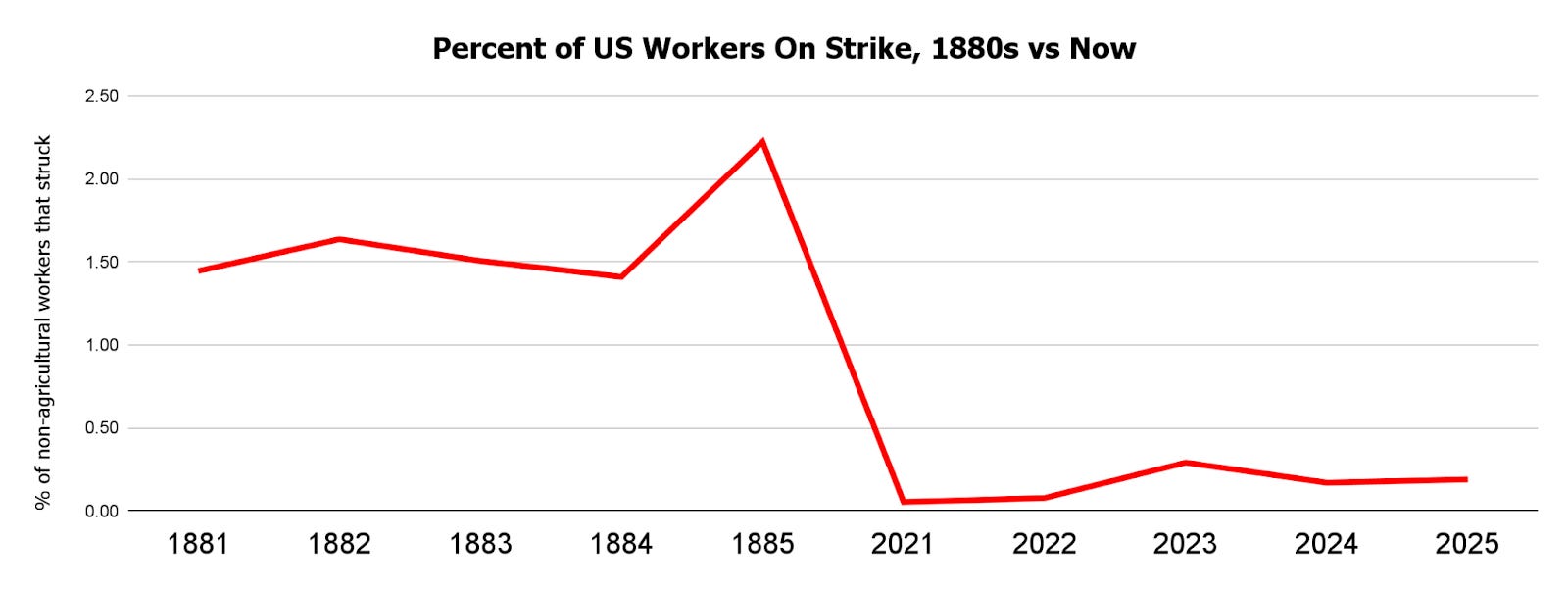
And, second, it was possible to lean on escalating economic strikes in 1884 and 1885 to generate momentum for May Day 1886, since the latter was also a strike for an economic demand on bosses, the eight-hour day. But as important as economic strikes are for empowering workers and raising wages today, they won’t generate momentum directly against ICE or Trumpism. And the experience of the past few weeks shows that the vast majority of workers, especially in the private sector, are not yet ready for the far riskier (and far more controversial) task of participating in a political strike. Easier onramps to fight Trumpism are needed — but ideally ones with more of a punch than one-off rallies.
So while it’s good to have May Day 2026 and 2028 as projected dates for joint action, the much more urgent and strategic question is how to start seizing openings and launching campaigns in the meantime that can generate enough momentum and mass involvement to make feasible widespread economic disruption and eventually even a general strike. Otherwise these planned-for dates, and the trainings to support them, will continue to mobilize mostly existing progressive and radical activists, not the tens of millions we need to win against ICE and Trump.
In Minnesota, grassroots momentum was sparked by external forces: the ICE siege begun in December 2025 and two murders of citizens by ICE and Border Patrol agents. Top-down horrors and bottom-up heroism in Minneapolis, in turn, has boosted anti-Trump momentum nationally. But we should expect Trump, Miller, and Homan to do everything in their power to control their thugs enough to avoid more viral killings of innocent white people, since all that bad publicity has clearly been counterproductive for their agenda. A sad reality of US politics is that the killings of immigrants like Silverio Villegas González, Jaime Alanis, Roberto Carlos Montoya Valdez, and Josué Castro Rivera did not spark anything like the widespread response to the deaths of Good and Pretti.
While ICE’s deportations and jackboot tactics will very likely continue to spark outrage over the coming months, we can’t rely on the regime to provide organizing energy for us. Nor should we put out calls for general strikes that have no realistic chance of becoming real. What we need instead is an orientation to seizing whirlwind moments and launching escalating fights for winnable demands like the successful effort that forced Avelo Airlines to break from ICE and Sunrise Movement’s push for Hilton now to do the same. Such efforts can sustain, accelerate, and organize the forward momentum sparked by courageous mass resistance in Minneapolis.
Organization
Stopping and eventually abolishing ICE depends on involving and developing the millions of Americans who are not coming to our meetings or protests. In other words, it depends on organizing. Without such a relentless outward-facing focus — especially on strategic industries and occupations where our side is weak — we’ll never have sufficient reach and legitimacy to turn high-momentum moments into real general strikes.
Emilia González Avalos, executive director of the Minneapolis-based community group Unidos, put it well on the Dig: “Participation needs to feel collective, not heroic. There is a plan to win and a path forward for a bigger we: lower the cost of participation and normalize resistance to millions of ordinary people. Our safety is in numbers.”
At a moment of upheaval like our own, organizing doesn’t require people first join democratic membership organizations like unions or the Democratic Socialists of America — though as a member of both, I would definitely recommend you join both, since powerful membership organizations are essential for our movement’s long-term success.
The first mass-scale step towards involvement in Minneapolis was for people to get trained to legally observe and record ICE’s actions. From the outside, this proliferation of observers might seem like something that just “spontaneously” happened, but in fact it required that the community organization Unidos prioritize this as an onramp into the moment — a mass recruitment and training process sometimes referred to as “absorption.” Unidos has now trained an astounding 30,000 people in response to ICE’s surge. And this orientation to scaling up reflected their strategic understanding of the importance of building a majoritarian movement.
As González Avalos explains:
What we had to ponder as organizers was “How do we stop being a specialty group?” … What is the on-ramp for a popular front? And so that’s how we thought about this constitutional observer on-ramp. … Movements are early, brave, and clear. But they are not majorities.
Though legal observation was a relatively easy and simple task, the process of doing it — especially in the face of ICE’s increased belligerence — became a transformational experience for countless Minneapolis residents. “It changes people,” notes González Avalos. “Now, all of these constitutional observers are wanting to do more.”
Indeed, Nammacher observes that those neighborhood signal groups were “absolutely decisive in being able to move in this moment” to make the January 23 strike a success. An astounding 4 percent of all residents in every neighborhood are now members of one of those chats.
Though much of this explosive movement now lies outside of formal organizations, Minnesota’s longstanding progressive unions and organizations have left a strong imprint on the broader fightback. “Organizing capacity has played a large role because what we’re seeing is that folks are mirroring where the center of gravity is,” notes Minister JaNaé Bates Imari, Co-Executive Director of ISAIAH, a faith-based, Black-led community group central to the statewide anti-ICE fightback. Concretely, she emphasized in her interview on the Dig the important role Minnesota’s leading progressive organization played in helping the movement remain remarkably non-violent even in the face of the most horrific provocations:
Part of what is happening in Minnesota is a needling by the federal government to try to get us to respond in a particular way. And Minnesotans across the [political] spectrum have said we will not take the bait. … No one [is] confused about who the peacekeepers are in the midst of what’s taking place.
Taking a cue from González Avalos, the key question all of us outside of Minnesota should be asking ourselves is: What are the key on-ramps to actively involve as many Americans in sustained struggle against ICE and Trump?
As important as events like No Kings have been and will continue to be for displaying mass opposition to Trump, big weekend rallies without clear next steps or easy on-ramps for deeper involvement won’t be enough to overcome Trump’s masked goon squad. Nor will the proliferation of anti-MAGA “tables” (coalitions) for progressive non-profits and unions to talk to each other. We need to pivot to talking to and involving the vast majority of Americans who are not on our email lists or membership rolls.
In towns faced with ICE surges, the first step is mass trainings for legal observers. Elsewhere, we should focus on winnable campaigns that raise anti-ICE demands on companies and local governments, not still-abstract calls for general strikes. Because so many people in our country feel like nothing they could do could ever make a difference, we need easy on-ramps that give people a sense of purpose and power.
Our side’s weak base among working-class people is the single most central obstacle to forward progress. There are deep structural reasons for this limitation. A century ago, even non-organized workers had far stronger ties to each other because they tended to live next to their co-workers, attend the same churches, and drink at the same bars. But economic decentralization, urban sprawl, suburbanization, and neoliberalism have dramatically eroded those organic working-class cultures. Consciously fostering widespread organization is both much harder and much more urgent than ever.
In our atomized country, it should come as no surprise that January 30’s “general strike” never materialized nationwide, especially since the action was called by small left-leaning student groups. Compare that with the January 23 Day of Truth and Freedom, which was called by influential organizations like Unidos, ISAIAH, SEIU Local 26, the St. Paul Federation of Educators, and the Minneapolis Federation of Educators. The legitimating strength of these organizations ultimately mattered more than the increase in momentum that emerged the next day when Alex Pretti was murdered on January 24.
But given that union density, the percentage of workers in unions, in the private sector is only 8.6% in Minnesota and only 5.9% nationwide, it’s not surprising that even January 23’s otherwise powerful action was weakest precisely in the places we need to be strongest: the corporations like Target, Hilton, Enterprise, and Home Depot that ICE depends on to function as well as all the other big companies whose CEOs have real leverage over the White House.
Whereas companies can’t make profits when their employees don’t show up to work, the titans of industry — and the White House — face no direct costs when local teachers and students walk out. School walkouts have an essential role to play in inspiring broader workplace and social disruption, but they’re not a substitute for it.
Recent experience abroad shows how crucial the private sector — especially its most central nodes — can be for defeating authoritarianism. Late on December 3, 2024, South Korea’s right-wing president Yoon Suk Yeol declared martial law. The militant KCTU union confederation threatened a general strike to save democracy and began immediately organizing rolling strikes in the most economically central metal and auto factories like Kia and Hyundai. This push, together with the broader pro-democracy movement of which it was part, forced the president out of office on December 14, 2024. (Yoon has since been indicted for leading an insurrection and is imprisoned — a fate that hopefully awaits America’s would-be dictator and his henchmen.)
To paralyze ICE and stop Trump, we urgently need far more private sector worker organizing. Non-union employees inside the belly of the corporate beast are no less courageous, but views towards Trump are far more uneven among blue-collar workers of all races and the organizing conditions facing blue-collar, white-collar, and tech workers alike are far more challenging. Whereas public sector workers and union members have more job protections, and college-educated professionals tend to have some financial cushion and autonomy, the norm for non-union workers in the private sector is paycheck-to-paycheck lifestyles, at-will employment, and fear of the boss.
Faced with this challenging context, we need far more campaigns like that of ICEOut.tech, an organizing initiative that in less than a week has already collected over 1,000 public signatures by tech workers and professionals demanding that their companies break from ICE. Couldn’t similar public petitions from workers of all skills and statuses be launched within Amazon, Target, Enterprise, Home Depot, and other ICE collaborating corporations?
Anybody at such companies should reach out to the Emergency Workplace Organizing Committee to get support launching such initiatives — but to get to scale, they’ll probably need the backing of big unions and progressive organizations. Without a serious investment in resources, it’s hard to imagine how we could make possible campaigns along the lines laid out to me by union strategist Chris Brooks:
Imagine all these groups canvassing Target stores across Minnesota (and then later across the country) inviting workers to come to a meeting where they get grounded in the campaign to fight ICE by building a committee in their store, using the meeting to map all their coworkers, and setting the goal of having all of them sign an anti-ICE petition in twenty-four hours and then organizing a massive community supported march on the boss to deliver that in the store. Film it and put it out there. Have all Target workers wear ICE Out buttons. Build to a one day Target strike.
At Target, Hilton, Enterprise, Delta, and beyond, mass organizing trainings tailored for specific company campaigns can give fired-up workplace activists the tools and encouragement they need to break beyond the already-convinced. Deep organizing techniques like systematic one-on-one conversations and escalating build-up actions — buttons, petitions, rallies, and the rest — have lost none of their relevancy for building power and overcoming fear in these challenging private-sector workplaces, where you can’t assume that fighting ICE and Trump is already widely or deeply felt enough to overcome prevailing moods of fear and resignation.
Parallel mass campaigns by consumers demanding that these companies and others break from ICE can create the momentum and permission structure for more employees to take the risk of joining the fight, as we’ve begun to see in Sunrise’s Hilton campaign of escalating sit-ins and noisy late-night rallies to pressure the company to stop housing ICE agents. Community members can also directly engage workers at these companies by passing out QR codes with links to sign petitions as well as information about upcoming actions. And radical organizations like DSA can start encouraging members to get jobs and organize at companies that are strategically central for the fight against ICE and Trumpism, as well as public sector workplaces that have huge disruptive power like city transportation and airports.
We also need far more education and educational materials about the ties of these companies to ICE, much of which is hardly common knowledge internally, let alone among the broader public. But it’s important to keep in mind that the most important lesson workers and community members can learn — that they have tremendous collective power — can only be taught and learned through the process of struggle itself.
Who Will Lead?
We got lucky that Trump chose to pick on a city and state with movement leaders like Emilia González Avalos, JaNaé Bates Imari, and Greg Nammacher. Without their strategic thinking, bold initiatives for mass participation, and push for organizational alignment instead of turf wars and shallow coalitions, Trump’s provocation in Minnesota may well have succeeded in achieving its ugly goals.
Unfortunately, this type of labor-community leadership is the exception, not the norm. One key reason that organization and momentum among working people is still much lower than it needs to be is that most US union and non-profit leaders have continued with business as usual since November 2024.
Mass movements don’t just happen. Someone has to take the initiative. This doesn’t mean those of us in the ranks have to wait for a green light from above. The impetus for almost every general strike in US history has come from below — only once the grassroots got the ball rolling did top leaders eventually (usually at the last possible minute) jump on board. As one San Francisco union leader in 1934 put it, “It was an avalanche. I saw it coming so I ran ahead before it crushed me.”
But in today’s atomized context, when feelings of powerlessness are still so pervasive, it’ll likely take a combination of grassroots initiative and serious organizational resources to scale up. On this question, like so many others, Minneapolis has pointed the way forward. “There’s nothing we’re doing that’s rocket science,” insists Nammacher from SEIU Local 26. “This can be replicated anywhere.”
Whether you’re a rank-and-file activist or the head of an organization with deep pockets, there’s no time to lose. The public is with us. We have the power — and a moral responsibility — to defeat ICE, Trump, and their billionaire enablers.
So let’s get to work. Do it right, and we might be taking work off together sooner than you think.
More
Work at a company collaborating with ICE? Reach out to EWOC to immediately get support organizing campaigns against ICE at your job.
Unsure if your company — or a company in your town — is working with ICE? Here’s a great research resource to find out.
Sign up here to get involved in Sunrise’s anti-ICE Hilton campaign.
This is a great article Eric! We need more contributions like this.
Striking is a muscle that requires practice, participation and education. There's no short cuts around this work but sometimes once a critical mass of this work has occurred, action can develop an exponential momentum.
Thanks, Eric Blanc, for this excellent analysis, balancing the need for flexible responses to authoritarian violence and provocations with the long term work of organizing on multiple levels.