

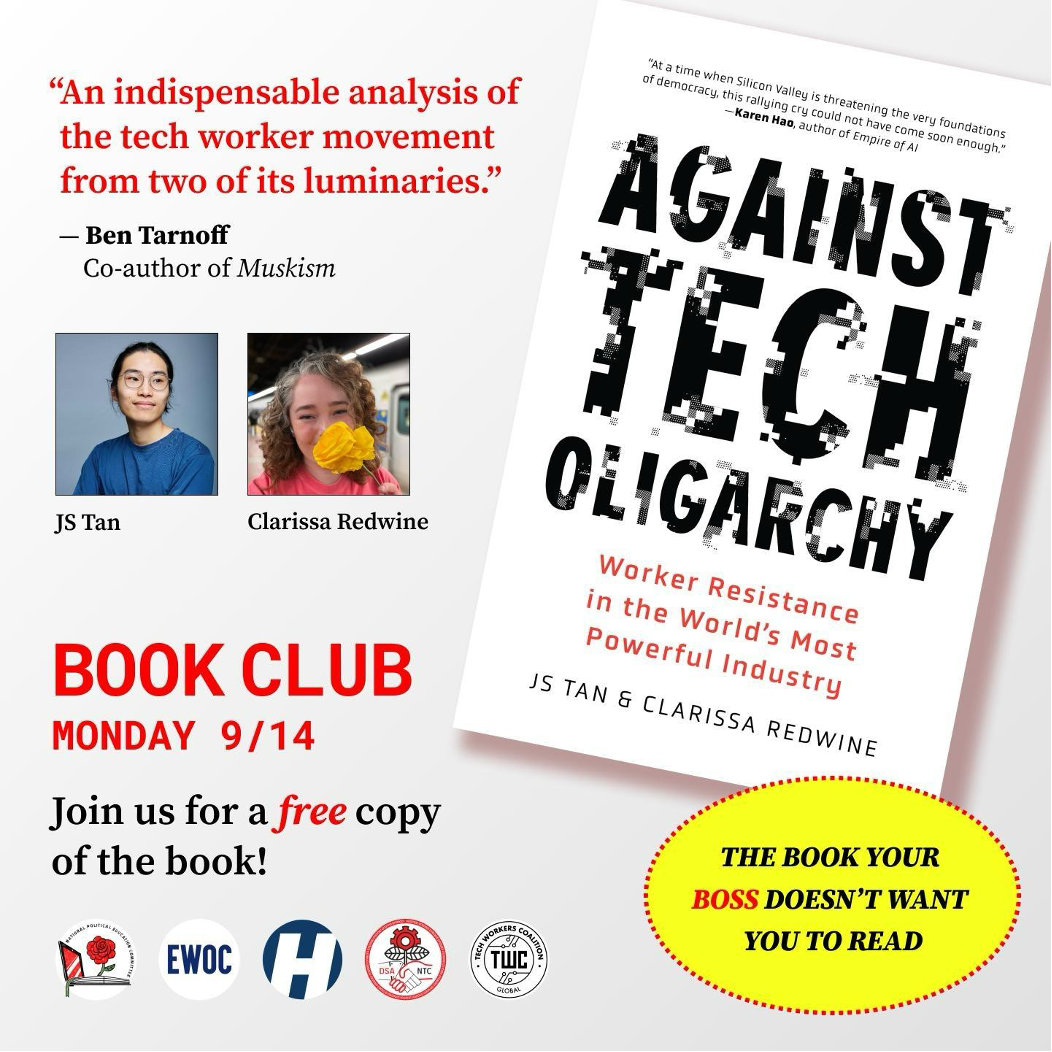
Sign up here to receive a free hardcover copy of Against Tech Oligarchy by attending the Monday September 14 virtual book talk
Eric Blanc: What is the overall state of tech worker organizing under Trump 2.0? It seems like lots of people must be angry with their companies’ capitulation to Trump but I imagine the fear factor is also a lot higher today.
JS Tan: Yes, we’re hearing from fellow organizers and tech workers that there are many people, especially at the larger tech companies, who are upset with their employer cozying up with Trump. This is related to the perhaps more salient change in the industry since about 2022, which is that tech employers have, as a whole, also adopted a far more anti-worker posture. Previously, tech workers had a lot of individual bargaining power because they were in such demand. If a job didn’t treat them well, they could just leave for another one. So to make sure workers stayed, employers showered us with perks, gave us a lot of discretion in our jobs, and, importantly, frequently lived up to the progressive values that many employees expected.
But in 2022, two things changed. First, interest rates shot up (a response by the Fed to cool COVID-induced inflation) which made employers far less willing to spend lavishly on tech worker salaries or perks. Second, many tech employers shifted to the right and cozied up to Trump because of their own employees’ unrest—which they saw as being fueled by progressive politics, or, as one newly minted trillionaire would put it, the woke mind virus. These two things meant that tech companies weren’t just all of a sudden laying off employees to cut costs, but explicitly targeting DEI folks, AI ethics teams, content moderation roles, and the like—all in an effort to reset the balance of power between workers and management. This is, we think, what many workers are upset about—not just that their employers are now capitulating to Trump, but that many have embraced a kind of conservatism in an effort to stave off the progressive politics that existed previously and underpinned worker resistance.
Clarissa Redwine: What all this means for organizing is that workers are more proletarianized. Compared to the late 2010s when many of our organizing conversations were about trying to convince tech employees that they were in fact workers, this is more or less no longer an issue. Now instead the problem is whether workers are willing to organize in this much more risky environment and in a labor market that no longer favors them. Since about 2022, this chilling of the industry’s labor relations has resulted in far less organizing—reaching perhaps its lowest point in 2024 and early 2025. But now what we’re seeing is new organizing emerge, this time based mostly on issues of AI.
EB: In your new book Against Tech Oligarchy you argue that the traditional model of unionization didn’t work in tech. Can you explain what the obstacles were and what strategic takeaways you draw from that experience/impasse?
JST: At its core, we think that the traditional union organizing playbook isn’t designed for the particularities of the tech labor process—and we say this as people who for many years believed in and tried to push this playbook onto the tech industry. The traditional playbook assumes that workers know beforehand where their leverage is; and in most workplaces, certainly in a factory or a school or a hospital, that leverage is very clear, alongside what might threaten or alter this leverage. When factory workers walk off the assembly line, nothing gets built, profit halts. But tech is quite different.
The value of a day’s work can, on one day, be worth nothing, and on another generate fabulous profits, all depending on factors outside the immediate control of the worker. This is perhaps most clear in the strike: a powerful, high-participation strike in tech would do little to stop a tech company from continuing to make money. That’s in fact exactly what we saw when the New York Times tech workers went on strike for their contract. They were a super militant shop, planned their strike on the most important day of the year—the day of the presidential election—and secured high participation in their strike pledge, only growing support day after day on the picket line. Yet, when they struck, nothing (major) broke and the pressure that they had banked on failed.
CR: That is why organizing in tech requires a different approach—one that allows and even encourages workers to explore their leverage. And in fact, because tech workers are such a heterogeneous bunch and do such different work on a day-to-day basis, we’d even expect that different teams, different roles, and employees at different companies would all hold different kinds of leverage, and that is something that needs to be interrogated.
EB: Which sectors and campaigns do you think are most strategic for tech worker organizing, around both material and political (anti-ICE, anti-authoritarianism, anti-Trump, etc.) demands? Are there any employees in particular whose structural power can be more readily leveraged?
CR: We’d argue that the movement never really cracked the code on how we organize the most powerful companies in the sector. The cloud hyperscalers, for instance, are a critical chokepoint in the AI stack and also in the industry as a whole. These are behemoth companies with hundreds of thousands of workers, and thus an example of why the traditional union playbook won’t work. The issues you mentioned—anti-ICE organizing, anti-authoritarianism—are issues that we need to take on today, yet it’ll take a decade or more to organize such a large and spread-out company for union recognition.
JST: The problem with structural power when it comes to tech work, however, is that a large portion of workers sit under the firm’s R&D division. And so this means that they are inherently future-oriented—building a new feature, or incubating a new product, and the like. Yes, maintaining these products/features is also a big job, but that’s not the majority of how these workers spend their time. This future-orientation means that withholding labor won’t hurt present profits. And so, we need to think strategically about who within each company, within each business model, has immediate power. That’s not something we have a generic answer for—and it’s in fact something that every campaign across every company needs to be thinking about depending on their business model, where they sit in the tech-ecosystem, what their firm’s competitive advantage is, etc.
EB: One less traditional approach to unionizing in tech is via pre-majority unionism (“minority unionism”), an approach I’m sympathetic to but which I’ve heard in practice in tech has sometimes resulted in unions being cliquey pockets of self-selecting leftists. What’s your impression on the balance and prospects for pre-majority unionism in tech?
JST: Pre-majority unionism is the reality for many workers in tech, especially those working at larger companies. That’s what the workers at Google have gone with. Any major tech company, with tens or hundreds of thousands of workers would likely have to go this approach because winning recognition for such a large unit would take years.
CR: From our perspective, we’re actually agnostic about whether a union is NLRB recognized (i.e., majority union) or a minority union, as long as it is a fighting union. And in fact the solidarity, pre-majority union at Google is a good example of this. They aren’t recognized, but that hasn’t stopped them from fighting and winning their demands with a minority of workers. In fact, acting as a union, where workers aim to win material gains from the boss, is critical at every stage in training militant organizers who can wield collective power at each stage of growth. The goal is not to stop growing and fight for only a minority of workers but rather to fight with the people you have in service of growth, demonstrating the value of collective action to workers who are new to the fight and practicing the mechanics of forcing concessions from management.
EB: One thing I loved about your book is that you were very sober about the strengths and limitations of all efforts done to date, and you don’t assume there is a proven model or path yet for how to organize this sector. On the other hand, at the end of the book I was hoping to read a bit more about what your hypotheses are about potential ways forward. My impression is that maybe the sweet spot for the foreseeable future is to organize and mobilize tech workers around widely held and deeply felt issue-based campaigns, without framing these as necessarily steps to unionization from the start.
JST: At the start of the tech worker movement, demands were concrete. When workers wanted their company to disengage from the military, they took collective action to push for that specific thing. And the experience of taking collective action together, and seeing how the boss responded, was a radicalizing event for many tech workers. When organizers shifted to building toward recognized unions, putting off clashes with the boss to fuel growth, demands became more abstract, complex, and distant.
Asking a coworker to stand with you against systemic sexism or brutal on-call policies is a much easier task than asking if they believe in unions. The experience of fighting for material change together is a far more powerful tool for building pro-union sentiment in your coworkers than any one-on-one conversation about what might be possible to win in a contract or the history of the labor movement. In short, organizing shifted from concrete, familiar demands to more abstract and distant goals, aiming to reach the largest number of supporters possible before taking action. And for many tech workers, this new approach to organizing, what we call in our book the Recognition Playbook, ended up delaying the critical experience of taking part in direct class conflict. This not only reduced the number of workers who saw the mask drop when they pressured the boss, it also atrophied organizers’ ability to find and embrace effective leverage.
CR: The hurdle right now in tech organizing is that workers haven’t discovered where their leverage is. To find out, we think, workers need to engage in class conflict and find opportunities to experiment with exercising leverage. That is in fact what we think is one of the big issues with the traditional union playbook: that it intentionally delays or avoids class conflict. In your typical campaign, organizers are always trying to bring new workers into the fold of the union drive, but the drive is all along meant to remain secret. And so what organizers do is have these one-on-one conversations with their coworkers until everyone is bought into the union, at which point you vote for the union and become recognized.
Sometimes international unions will suggest running a shop-wide issue campaign where the goal is to sign on more union members (not to win material gains), but besides that, workers never actually engage in any direct conflict with the bosses through this whole process. Only in the end, when they go on strike while bargaining their contract, do workers finally get to experience class conflict—but by that point it is too late: workers in tech will never have had the chance to practice exercising their leverage, or get a glimpse of the boss’s counteroffensive.
JST: Workers need to organize with a conflict-forward mindset. They need to encourage class conflict so that workers can start to figure out how to organize in a way that can actually threaten their employers’ bottom line.
EB: What do you think about the prospect of recruiting young people to salt tech? It seems clear to me that tech is an extremely strategic industry, I’m not sure why we wouldn’t want to orient to getting salts in there, even if primarily to boost issue-based campaigns at first.
CR: I actually salted at my first tech job after the Kickstarter union drive and that was an incredible experience. Tech workers are hungry for autonomy, social good, and security. The challenge is showing coworkers what a fighting union is in practice before ever bringing up the U-word, which can divide workers who would have otherwise been united behind a specific demand. Salting is going to be crucial in tech moving forward and there is an organic movement of tech workers who’ve left or been pushed out of their union drives who go on to salt independently, joining the next company with an intent to unionize. However, salting in a more traditional way where an international targets a specific company is extremely difficult because of the nature of tech work where jobs are highly specialized.
JST: The tech industry is extremely heterogeneous and that means not all companies are going to have the same kind of importance in the industry as a whole. Organizers should move towards the critical chokepoints or otherwise key campaigns to support them. However, proactive, targeted salting is not always possible. Because of this challenge, many tech workers have adopted the perspective that they will organize wherever they land. And that is a very exciting cultural shift in labor, where workers are salting whether they are backed by an international or all on their own.
EB: Do you think the introduction of AI into tech workers’ workflows and their companies will potentially create openings for larger numbers of workers seeing themselves as expendable and precarious workers in need of organization, like skilled factory workers did a century ago when Taylorist attacks on their autonomy pushed them into unionizing?
JST: For many workers, yes—agentic coding systems have in many ways made it impossible for workers to really see coding as this artisanal craft, as many did previously. But there is also a group who see themselves as “high-agency” workers and hope to use these agentic coding systems to accelerate their careers. And in fact, these two wolves can exist in one person. For instance, a worker can feel proletarianized by these new AI developments in the field, yet may be motivated to double down on using them because they are worried these tools will narrow the window for future job/career mobility (i.e., the permanent underclass)—and so, they may embrace grind culture and 996, largely for individualistic reasons.
CR: The feeling among many tech workers is that AI is a reserve army that will do your job for zero salary and never sleeps. You can either adapt, or be replaced. But when your company is no longer pretending to be stewards of public good, and they are actively trying to force you down and out, then workers naturally start to question why they should be building this tech in the first place. So although there is increased precarity, workers still hold the keys to their employers’ bid in the AI race, and that is an opportunity that can revitalize the tech worker movement and shift the ground under the tech oligarchy as we know it.
More
Join the authors virtually at 3:30pm ET this Monday September 14 and be gifted a FREE hardcover copy of Against Tech Oligarchy
LaborLab has developed a new union-buster search tool and cost calculator. It’s a tremendously useful resource, please use and share widely.
I did a long interview with The Jacobin Show about the lessons and relevance of Milwaukee’s Sewer Socialists: video here, transcript here.
Who Moves America, a fantastic new film about the struggle of UPS drivers, is now out in theaters. Here’s a list of upcoming screenings, including opening night Monday September 14 in NYC