

Donald Trump is setting Iran and the world on fire. And there’s every reason to think he’ll keep escalating abroad as his regime gets weaker and less popular at home.
But we should be honest: this didn’t start with Trump. For decades, both parties have shared the same basic commitment to U.S. military dominance over the world. Fifty-five percent of House Democrats voted in favor of the most recent US armed forces budget.
Establishment liberals like Chuck Schumer and Hakeem Jeffries prefer a more stable and less erratic version of empire. That’s why their objections about the Iran attack are about process and “strategic clarity,” not a break with the underlying goal of U.S. supremacy. For her part, Kamala Harris on the campaign trail promised to “ensure America always has the strongest, most lethal fighting force in the world.”
What almost never gets seriously questioned in mainstream US politics is the premise itself: that Washington has the right to bomb, invade, or attack any country across the globe whenever it decides it has a sufficiently good reason. There are important exceptions — Bernie Sanders, Alexandria Ocasio-Cortez, James Talarico, and others have taken clearer antiwar stances.
But it’s not enough just to oppose this war on Iran. Nor is it enough to demand an end to US aid to Israel. As long as the United States spends almost $1 trillion a year on the military, there will be overwhelming institutional and political pressure to use that machine, justify that machine, and keep expanding that machine — while insisting that there’s no money at home to make life affordable for working people.
Anti-MAGA forces need to stop treating military-budget cuts like a fringe talking point. In the midterms and in 2028, we should agitate for serious reforms to the US war machine. What’s a reasonable-but-ambitious starting point? Cut the armed forces’ $886 billion budget in half.
That’s not pie in the sky. A military budget of “only” about $443 billion would still leave the United States the biggest military spender in the world. But it could mark a real step away from the strategy and practice of imperialism.
Humanity needs international cooperation, not conflict. The United States’s deepening rivalry with China threatens to push the globe into another catastrophic great-power spiral at precisely the moment we need to confront actual existential questions like climate breakdown and how to develop AI slowly and carefully enough that it doesn’t wreck our livelihoods or human civilization.
And with so many working-class Americans barely hanging on, freeing up roughly $500 billion every year would go a long way toward making life in this country livable again.
We are constantly told that universal childcare is too expensive, housing is too expensive, healthcare is too expensive, public transit is too expensive, climate adaptation is too expensive. One simple solution is to cut the military budget in half.

Better Ways To Spend Half a Trillion Dollars
So many life-changing policies would become possible if America halved its military budget. Here’s what $443 billion yearly could fund if directed fully toward each item:
1. Medicare for All — Most estimates put the net new federal cost at $300-400 billion/year (replacing premiums, copays, and deductibles currently paid privately). $443 billion/year would essentially fund the transition to a single-payer system, covering every person in the country while eliminating out-of-pocket costs.
2. End hunger — Making breakfast and lunch free at every school costs about $20 billion per year. Expanding SNAP and WIC to fully eliminate food insecurity would run another $50-100 billion. $443 billion could end hunger in America and completely transform the school nutrition system with money to spare many times over.
3. Build millions of public housing units — Average cost to build a quality affordable unit is roughly $200,000-$300,000. At $443 billion/year, you could build 1.5 to 2 million new public housing units every single year. The entire estimated national shortage is about 4-7 million units, so you’d close the gap in three to four years and then have an ongoing budget for maintenance, renovation, and continued construction.
4. Cancel all medical debt — Total medical debt in active collection is estimated around $195 billion. You could eliminate every dollar of it in the first year and still have over $240 billion left for other health investments that same year.
5. Cancel all student debt — Total outstanding student debt is roughly $1.8 trillion. You could wipe it all out in about four years, then fund free public college permanently going forward with money to spare.
6. Make public college and trade school free — Total tuition revenue at all public colleges and universities is around $80-90 billion per year. $443 billion covers that almost five times over. You could eliminate tuition, massively expand capacity, and fund living stipends for students.
7. Universal childcare and pre-K — Estimated cost for a universal, high-quality system is roughly $70-100 billion per year. $443 billion would fund a system where every family in America has access to free or near-free childcare from birth through age five, with well-paid unionized staff, and still leave $340+ billion on the table.
8. Green energy transition jobs program — The entire Inflation Reduction Act was about $370 billion in climate spending spread over a decade. $443 billion per year would be roughly twelve times that annual rate. You could retrofit every building in the country, build out renewable energy infrastructure nationwide, and fund union-wage jobs for every displaced fossil fuel worker many times over.
9. National high-speed rail network — California’s single high-speed rail project is estimated around $100 billion. $443 billion/year could build a comprehensive national network connecting every major metro area within a decade, something comparable to what China and Europe have built.
10. Repair all deteriorating infrastructure — The American Society of Civil Engineers estimates the US infrastructure gap, the gap between the amount of money needed for basic infrastructure maintenance versus how much is actually allocated for it, at roughly $2.6 trillion over ten years. $443 billion yearly covers that completely — every bridge, road, dam, water system, school building, and electrical grid — and leaves room for new construction.
11. Universal home and community-based care — There are roughly 800,000 people on Medicaid waiting lists for home care for elderly and disabled people. A comprehensive universal program would cost an estimated $150-200 billion per year. $443 billion fully funds this with well-paid caregivers and eliminates every waitlist in the country.
12. Federal jobs guarantee — Most estimates for a program guaranteeing a $15 per hour job with benefits to anyone who wants one range from $300-500 billion/year depending on uptake. $443 billion lands right in that range, potentially employing 10-15 million people in public works, caregiving, environmental restoration, and community development.
13. Expand and strengthen Social Security — Eliminating the taxable earnings cap is the usual funding mechanism, but $443 billion/year could increase average benefits by roughly 35-40%, lower the retirement age, and extend the trust fund indefinitely. That would lift virtually every senior out of poverty.
14. Community health centers and mental health services — There are currently about 1,400 federally qualified health centers. Estimates suggest we need roughly 8,000-10,000 more to provide universal primary and mental health access. At roughly $5-10 million per center for construction and staffing, $443 billion could build out the entire system in a single year and fund operations for decades.
15. Weatherize and retrofit every home — Average cost to fully weatherize a home is roughly $5,000-$10,000. There are about 35-40 million homes that need it. Total cost: $200-400 billion. $443 billion/year does the entire country in one year, cutting energy bills for tens of millions of families immediately — and reducing carbon emissions.
16. Universal paid family and medical leave — A comprehensive 12-week paid leave program is estimated at roughly $50-75 billion/year. $443 billion funds this nearly six times over. You could offer six months of paid leave and still have hundreds of billions remaining.
17. Fully fund and transform veterans’ care — Veterans Affairs’ (VA) current budget is around $400 billion but is plagued by staffing shortages, long wait times, and crumbling infrastructure, with Congress consistently failing to fund it adequately. $443 billion a year could double VA healthcare staffing, eliminate every wait list, build state-of-the-art facilities in every region, fully fund mental health and suicide prevention programs, end veteran homelessness (roughly 35,000 veterans are unhoused on any given night), and guarantee every veteran world-class care without bureaucratic delays — all while keeping the existing VA public healthcare system rather than privatizing it.
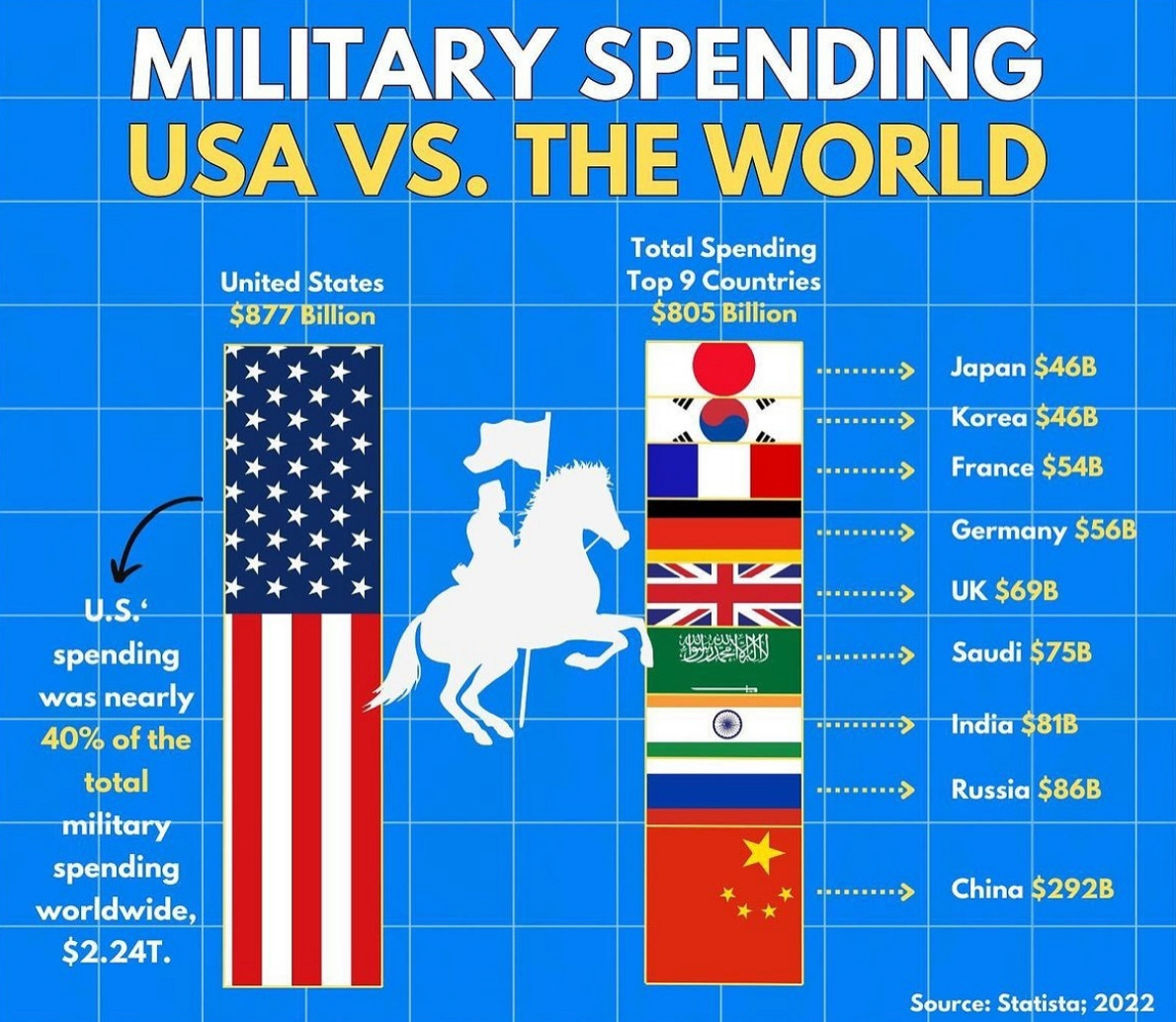
The staggering thing about this list is that even the most expensive items rarely exceed $443 billion individually. You could fund several of them simultaneously with half the military budget. For context, the US spends more on its armed forces than the next nine countries combined.
Peace Is Possible
Even though more Americans want to cut the military budget than expand it — and even though this war on Iran is widely opposed — the military itself as an institution remains remarkably popular. Cutting the military budget in half is ambitious and would be controversial, since so many communities across the US economically rely on supplying goods and services to the military. Why not start with a smaller proposed cut? This is a reasonable question.
My response is, first, that $443 billion a year is still a huge amount of money. Second, there’s a huge amount of fat that can be quickly and easily cut because military spending is rampant with waste, irrationality, and lack of financial accountability. Third, there is strong precedent for a massive military cut: military spending was cut in half from 1945 to 1946 in the wake of World War II. By 1948, the armed forces budget had been cut 89 percent from its wartime total, as factories converted to peacetime use. The same conversion strategy used then — deep Pentagon cuts combined with job guarantees, wage protections, retraining, union-led transition planning, and long-term public contracts for civilian production — can be used to transition us today away from an economy oriented towards destruction, towards one based on producing services and providing goods that humans actually need.
Finally, along the way to our goal of halving the budget, we should also support intermediary military budget cuts like the 10 percent proposed by Bernie Sanders. Realistically, it will probably be through the accretion of such partial steps forward that we’ll achieve our goals. In part, that’s because it will take time to reconfigure and transition the plants currently being used to produce weapons and military goods. But in that process, it’s crucial we keep the public’s eye on the prize of a dramatically different US military.
The problem with modest proposed military budget cuts on their own isn’t just that they don’t free up enough money for domestic programs. It’s also important that we spark a serious national debate about how the United States can begin relating to the world in a way that does not hinge on domination and exploitation.
In 1967, Martin Luther King Jr. noted that the US government was the “greatest purveyor of violence in the world.” That remains true today. But it doesn’t have to remain true tomorrow.
More
Wars abroad are inseparable from ICE’s war at home. Sign up here to get involved in the Schools Drop ICE campaign to force our colleges to break their contracts with the corporations propping up ICE.
Do you have organizing experience? Please sign up here to become a volunteer organizing coach for Schools Drop ICE! Over a thousand students and faculty have already signed up, so it’s all hands on deck to help them launch powerful campaigns.
If you have any research experience and would like to volunteer for Schools Drop ICE, please send an email to schoolsdropice@gmail.com .
A film everyone should see which reinforces everything you've said, Eric, is Earth's Greatest Enemy by journalist/filmmaker Abby Martin:
https://earthsgreatestenemy.com/
"Peace is not a great business model if you sell weapons." ©
***
The Triumph of the Military-Industrial Complex | Who Rules America:
youtube.com/watch?v=tWFjadLGkeU
***
Why is the US always at war?
youtube.com/watch?v=SzryRhH79Cc
youtube.com/watch?v=iLbAU3xWqW0
***
Blackwater. How the U.S. privatized WAR:
youtube.com/watch?v=Aycfr8Jcqb4
***
How 5 Companies Control the Entire U.S. Military:
youtube.com/watch?v=Rg6_tdzH6ho
youtube.com/watch?v=ZVSNF6Td3c8
youtube.com/watch?v=lDB3L23UMCQ